
Five days. Five releases. One AI engine.



From the desk of Ari Baranian, Co-Founder & CEO:
We named our AI engine Mira. In Latin it means to see. In its reflective form, to mirror.
The name matters because the problem it describes is real. I spent years as a structural engineer inside design firms. Every project generates knowledge that should compound over time: Details with field-tested quality, design decisions that hold up, standards earned through hard experience. Instead, this knowledge disappears. The next project starts from scratch. The next hire learns by asking around.
We made a deliberate choice about how to solve it. There's a version of Pirros where we build one thing really well and call it done—a detail manager, a family library tool, a QA checker. Any one of those would be useful. Plenty of companies have done it. We went a different direction because the problem isn't any single workflow. It's the connective tissue between all of them. Solutions built to work together perform better than tools pieced together in isolation.
Mira is that connective tissue. Firm-specific intelligence built from your actual work: Your details, your families, your standards, your project history—all running underneath every Pirros product and making them stronger together than any one of them could be alone. Mira sees the firm, not just the file.
Building her required the same mindset we're describing. We don't ship fast by cutting corners... we ship fast because our team has internalized full ownership over what they build. Earlier this year we paused the roadmap for three days, gave our engineers a rented house, and told them to ship something real. Twelve projects came out of it. Two are already in production. One opened an entirely new market.
That’s the culture that makes a launch week like this one possible. Not a sprint. Not a stunt. The natural output of a team that has internalized what it means to build with full ownership.
Five days. Five releases. One ecosystem. Each day this week, we’re showing you a different expression of what Mira can do.
Day 1: Mira, the agent for Revit
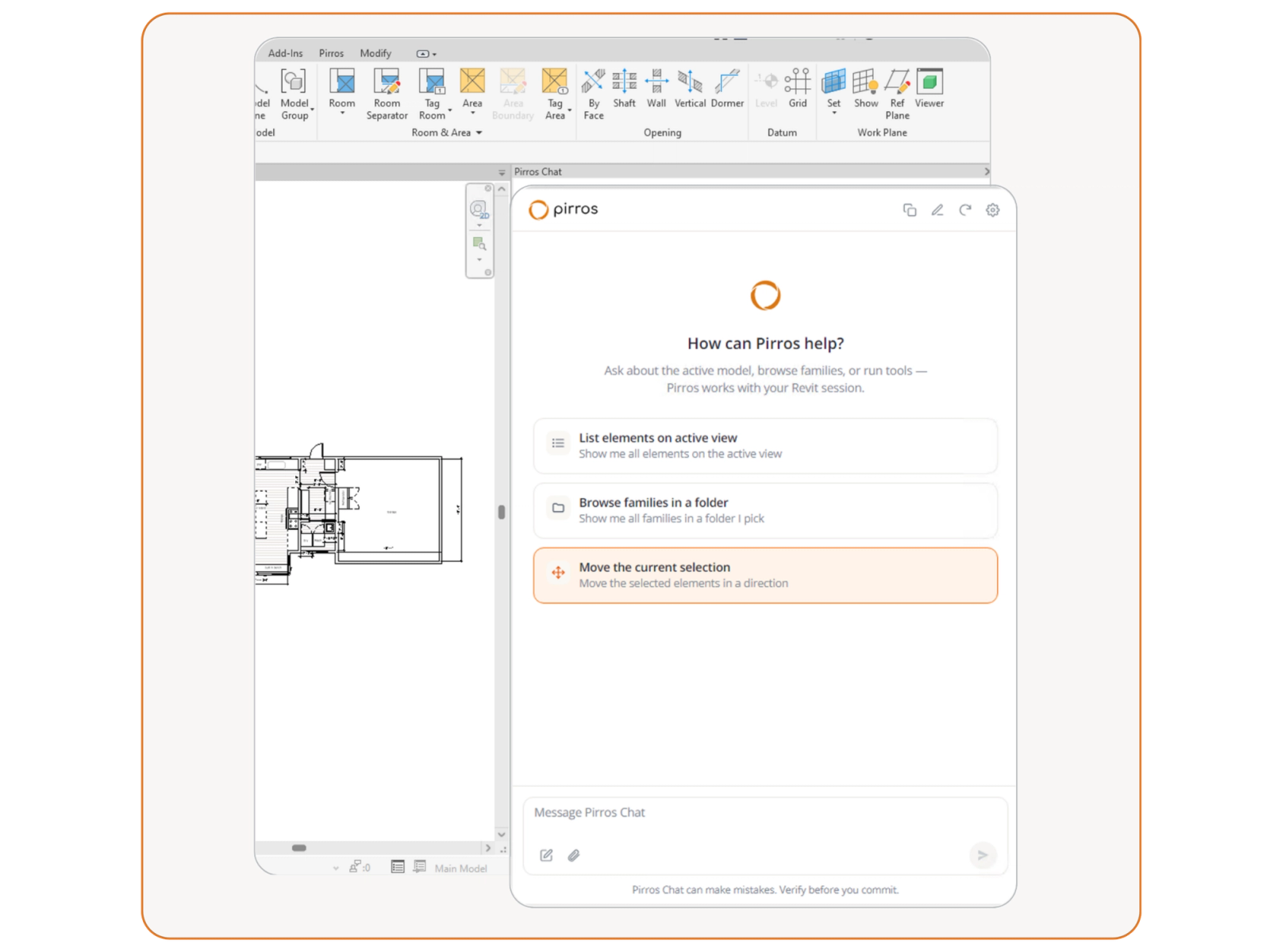
Talk to Mira inside Revit.
Built on frontier AI models and tested by real designers on real projects, this agent goes beyond a standard API integration or MCP—leveraging dynamic tools and skills to access new possibilities to interact with, control, and create in Revit. Trained on design-specific production workflows, Mira outperforms the Revit-native assistant on every test, every time.
Get Mira, the agent for Revit.
Day 2: Detail & Family Health Scores
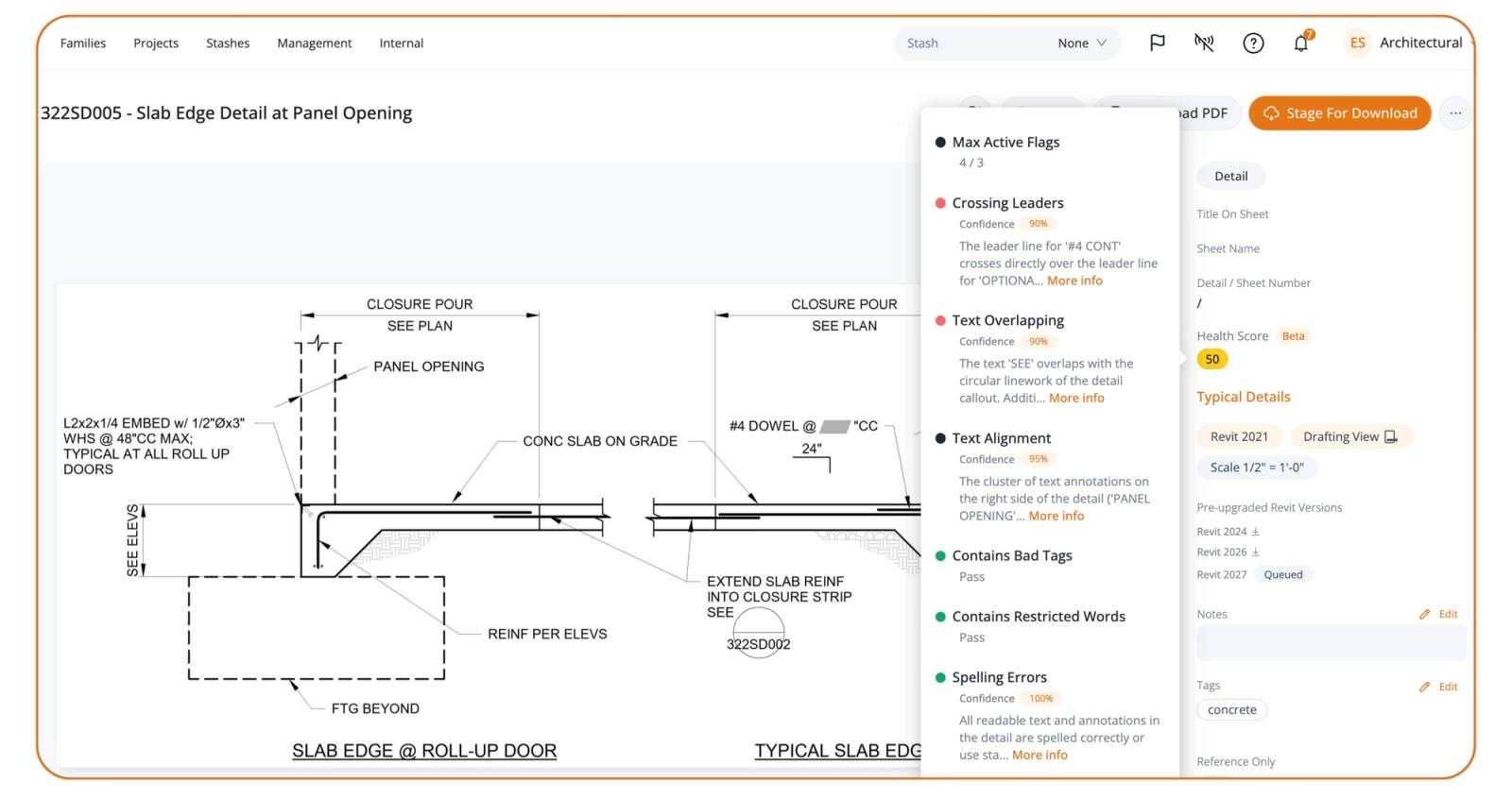
Mira grades your content against your firm's standards.
A standard library tells you what should be good. A health score tells you what actually is. Mira reads every family and detail in your standard library and across every project—evaluating file size, parameter count, geometry, annotation, and custom criteria that you define—and scores each one. Users now have confidence in the quality of an asset even if it hasn't yet been promoted to standard. You see the grade. You see the reason. You know what to fix to make it quality, or cut it.
You can't fix what you don't know is broken.
Day 3: Auto-Sync to Latest
Keep your Revit models automatically in sync with your Pirros library.
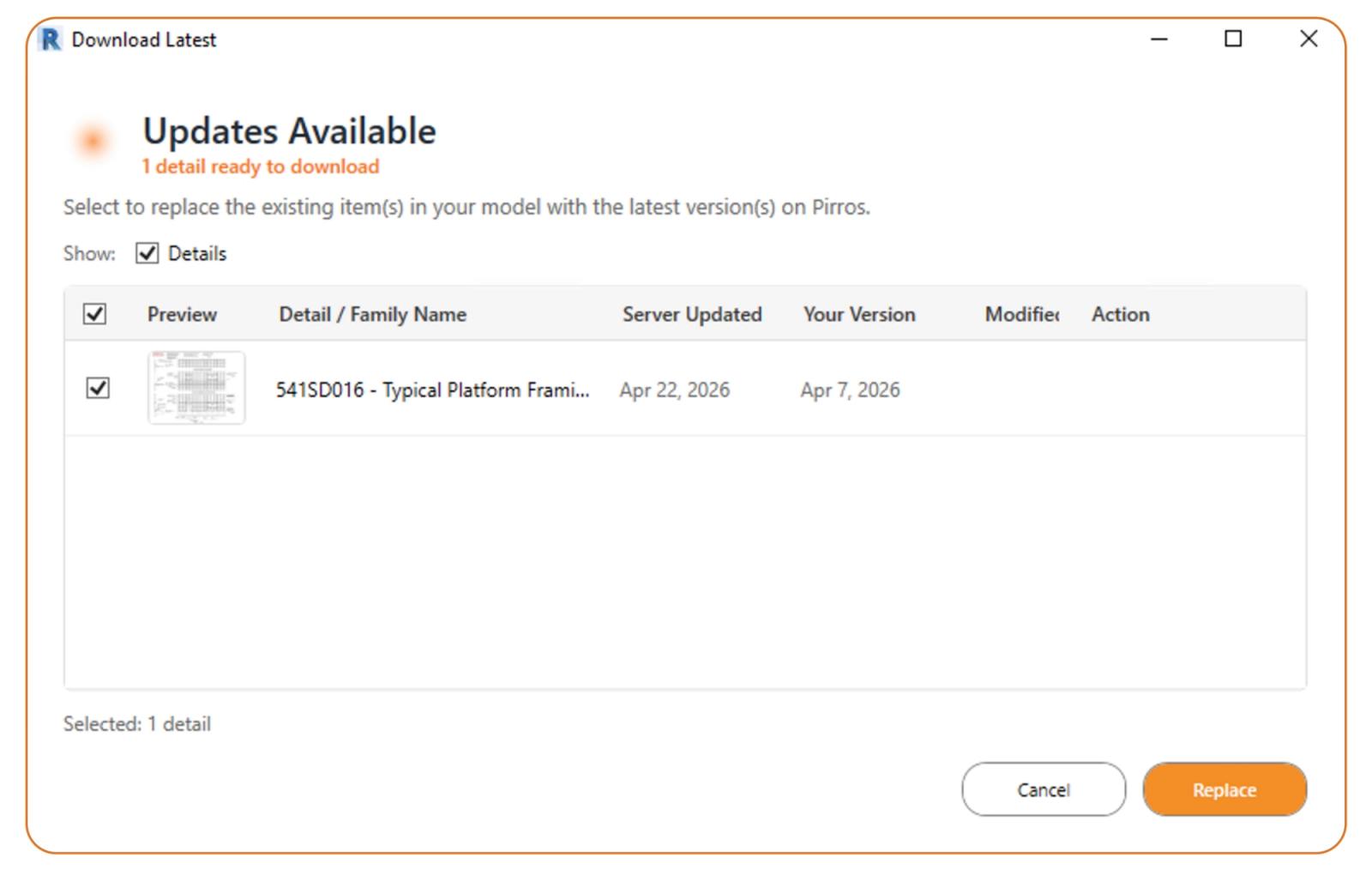
Your Pirros library evolves over time as details get refined, families get updated, and standards change. But the versions of those details and families already placed in your active Revit models stay frozen at whatever version was current when they were inserted. Auto-Sync to Latest is built for that gap.
Run it against any Revit model connected to your Pirros workspace, and Mira identifies every detail and family in the model that has a newer version in the library, shows what's changed between the two, and lets your team decide which ones to update. Selected items update in one click.
Think of it as a "check for updates" button for everything Pirros-managed in your current file.
Day 4: Multi-Version Intelligence
Pirros stores each detail and family in the Revit version it was uploaded from. Say your firm is moving from Revit 2024 to Revit 2025. Every detail and family currently saved in 2024 needs a 2025 native version too. The traditional workaround is to open each file in the newer Revit, save it, and re-upload.
For a full library, that's a project on its own.
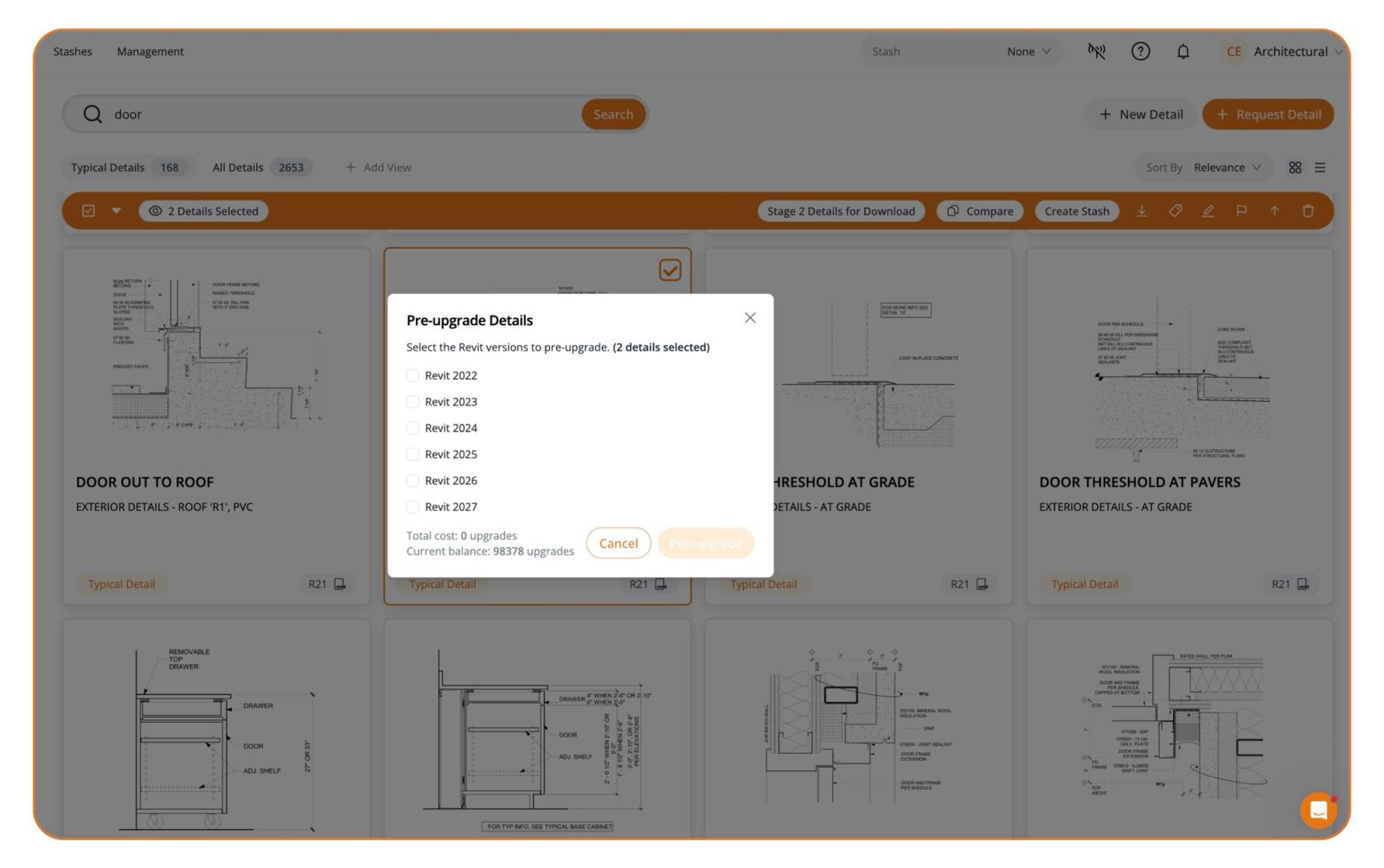
Multi-Version Intelligence skips the manual step. Pick a single item or a batch, choose any Revit year as the target, and Mira runs the conversions in the cloud. Every detail in Pirros now carries multiple Revit year versions, all stored alongside the source. Click any detail, toggle to the year you need.
Day 5: Sheet Builder
Before I tell you what it does, let me tell you what Pirros is, because Sheet Builder only makes sense in that context.
Pirros is the single place where architecture and engineering firms find, compare, reuse, and standardize their Revit details and families across every project, team, and office. That's the core of what we do. We exist because institutional knowledge, the details that work and the standards that hold up, shouldn't have to be rediscovered on every project.
Your details are already in Pirros. Now you can drag, position, and configure them into a sheet layout before you ever open Revit. When you're ready, download it. Revit creates the sheet automatically with every detail exactly where you placed it.
And because the layout lives in Pirros, it's reusable. Build a standard wall section sheet once. Use it on the next ten projects. Adjust it, version it, share it across teams.
No more hunting for details across models and folders. No more placing them one by one onto a sheet only to do it all over again next project. Sheet setup becomes a reusable asset instead of work that gets redone every time.
This is just the beginning.
This isn't a roadmap announcement, and there are no waitlists or "coming in Q4" disclaimers. Every release is a working feature your team can open up and use the same day it ships.
If you want to see the full picture come together, follow along this week and bookmark our blog or save your spot for Friday's live walkthrough where I'll show everything we shipped and how it all fits together. By the end of the week, you'll see why we built it this way, and why what comes after only gets bigger.
See it all here.
Join me for a live walkthrough I did of everything that launched this past week, and what it means for how your firm produces, manages, and delivers construction documents.
The best AE firms don’t just do great design work. They build systems that let them do great design work consistently across projects, across teams, across years. The knowledge they’ve earned shouldn’t evaporate when a project closes or a senior person walks out the door.
Mira is the infrastructure for that. A brain that sees the whole firm. That gets smarter with every project. That turns scattered history into reusable standards, and reusable standards into a compounding advantage.
Hope to see you on Friday.
—Ari

Get your details closer to design-ready than they’ve ever been