Duct Smoke Detector Requirements
Sources: 2021 International Mechanical Code (IMC) Section 606 and 2021 International Building Code (IBC) Section 907
Check your set instantlyA return air system over 2,000 cfm needs duct smoke detectors in its return, upstream of filters and outdoor-air and exhaust connections. Area smoke detection covering everything it serves can replace them. Return risers serving two or more stories on systems over 15,000 cfm need one at each story. Detectors shut the unit down.
The Pirros Quality Management System can check every air handler on your mechanical equipment schedule for a required duct smoke detector in your set and Revit model, instantly.
How to check the code requirements
Duct detectors start on the mechanical equipment schedule. Each unit's design airflow decides whether it needs one. The plans, controls diagrams and fire alarm plan show whether it has one.
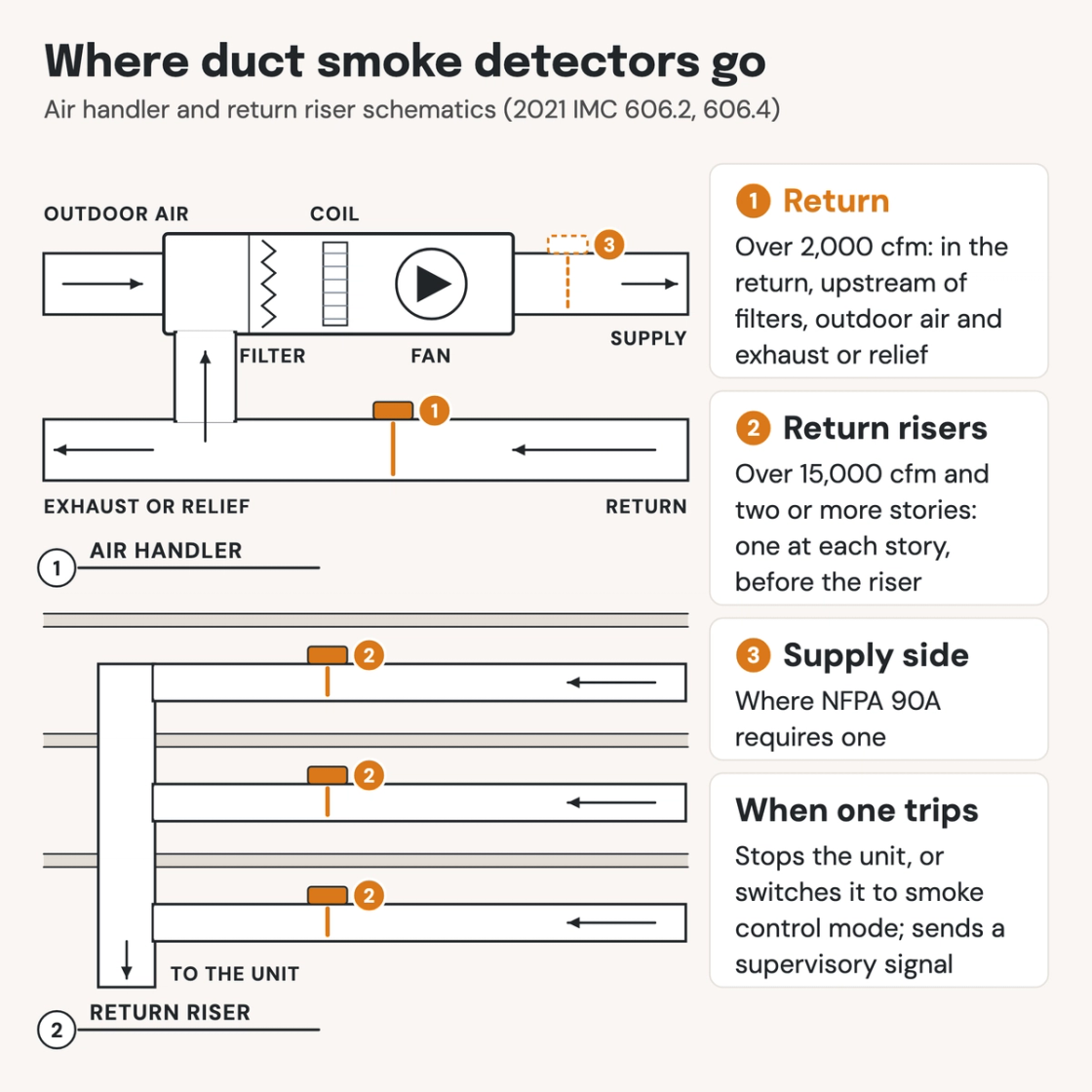
- Read the cfm off the schedule. A return air system over 2,000 cfm needs return-side detection (IMC 606.2.1). Add up the capacities of units that share ducts or plenums (606.2.2).
- Place the detector upstream. Show it in the return duct or plenum, ahead of the filters and of the outdoor air and exhaust or relief connections (606.2.1). It has to see the whole airflow (606.3).
- Check the return risers. Where a return riser serves two or more stories on a system over 15,000 cfm, show a detector at each story (606.2.3). Put it before the riser connection.
- Decide on area detection. If area smoke detectors on the fire alarm system cover every space the unit serves, the return detector can go (606.2.1 exception). Those detectors must still shut the unit down (606.4).
- Show the shutdown and the signal. Note on the controls diagram that the detector stops the unit, or switches it to smoke control mode (606.4). On the fire alarm plan, it reports as a supervisory signal (IBC 907.3.1).
- Show the access. Each detector needs access for inspection and maintenance (IMC 606.3). Show the access panel in the duct and, where it sits above a ceiling, the ceiling access.
Duct detectors connect two disciplines. The mechanical engineer decides which units need them, and the fire alarm designer wires them in as supervisory devices. The code analysis records whether the building needs a fire alarm system, which decides how they report. The rules are in IMC Section 606 (ICC's free viewer). On a drawing set they sit on the mechanical schedules, plans and controls diagrams. That is where an AI-powered quality management system reads them for MEP engineers.
How Pirros checks the set
The Pirros Quality Management System reviews projects against code requirements, firm standards, and project specifications, then assigns, tracks, and resolves issues before they become RFIs or rework.
- Reads every sheet in your set against the codes you pick for the project: the IBC, ADA and regional codes.
- Every finding names the sheet, the location and the section behind it.
- Findings are surfaced, never auto-applied. Your reviewer confirms, dismisses or escalates.
Requirements at a glance
| Element | Requirement | Section |
|---|---|---|
| Return air systems over 2,000 cfm | Smoke detectors in the return air duct or plenum, upstream of any filters, exhaust air connections, outdoor air connections or decontamination equipment. | IMC 606.2.1 |
| Area detection instead | Not required in the return where area smoke detectors on a fire alarm system protect every part of the building the system serves. Those detectors must shut the system down too. | IMC 606.2.1 (exception), 606.4 |
| Single-room systems | Not required where the system cannot spread smoke beyond the walls, floors and ceilings of the room or space where the smoke starts. | IMC 606.2 (exception) |
| Shared ducts and plenums | Units sharing supply or return ducts or plenums with a combined design capacity over 2,000 cfm get return-side detectors, as in 606.2.1. | IMC 606.2.2 |
| Fan-powered terminal units | Units of 2,000 cfm or less each need no detector of their own. Return detectors, approved area detectors in the return plenum, or an area system must shut them down. | IMC 606.2.2 (exception) |
| Return air risers | Serving two or more stories, on a return system over 15,000 cfm: detectors at each story, upstream of the connection to the riser. | IMC 606.2.3 |
| Listing | Listed and labeled for air distribution systems and complying with UL 268A. Listed for the duct's air velocity, temperature and humidity. | IMC 606.1 · IBC 907.3.1 |
| Installation | Installed under NFPA 72 to monitor the entire airflow, return and exhaust or relief air included, with access for inspection and maintenance. | IMC 606.3 |
| On activation | Shut down the air distribution system as its listing requires. A system that is part of a smoke control system switches to smoke control mode instead. | IMC 606.4 |
| Supervision | Connected to the fire alarm system where IFC 907.2 requires one, with a visible and audible supervisory signal at a constantly attended location. Where a supervising station monitors, it reports only as supervisory. | IMC 606.4.1 · IBC 907.3.1 |
| Supervision exceptions | No attended-location signal where the detector sounds the building's alarm appliances. Without a required fire alarm system, a visible and audible signal goes to an approved location, and trouble shows as air duct detector trouble. | IMC 606.4.1 · IBC 907.3.1 |
| Not area detection | Duct detectors cannot stand in for required open area detection. | IBC 907.3.1 |
| NFPA 72 and NFPA 90A | To stop smoke recirculating, a detector approved for duct use goes on the supply side of air-handling systems where NFPA 90A requires one. Return detection that other NFPA standards require goes where air leaves each smoke compartment, or before a shared return. | NFPA 72 (2019) 17.7.5.3.1, 17.7.5.4.2.2 |
These numbers are from the 2021 IMC and IBC; check the edition and amendments your jurisdiction enforces. Where a jurisdiction also adopts NFPA 90A, its duct detector rules apply too, and NFPA 72 points to them. The 2021 IBC references the 2019 edition of NFPA 72, whose section numbers this page cites.