NEC 210.8 GFCI Requirements for Commercial Spaces
Sources: 2023 National Electrical Code (NFPA 70), Section 210.8
Check your set instantlyNEC 210.8(B) requires GFCI protection outside dwelling units in 15 locations. They include bathrooms, kitchens, food and drink areas with a sink, rooftops, outdoors and within 6 feet of a sink. It reaches 125 to 250 V single-phase receptacles up to 50 A and three-phase receptacles up to 100 A. Both must be at 150 V or less to ground.
The Pirros Quality Management System can check the GFCI protection of every receptacle on your power plans and panel schedules in your set and Revit model, instantly.
How to check the code requirements
GFCI protection is decided room by room on the power plan, then carried to the panel schedule. Start from the room type, not the receptacle: many 210.8(B) items cover every receptacle in the room.
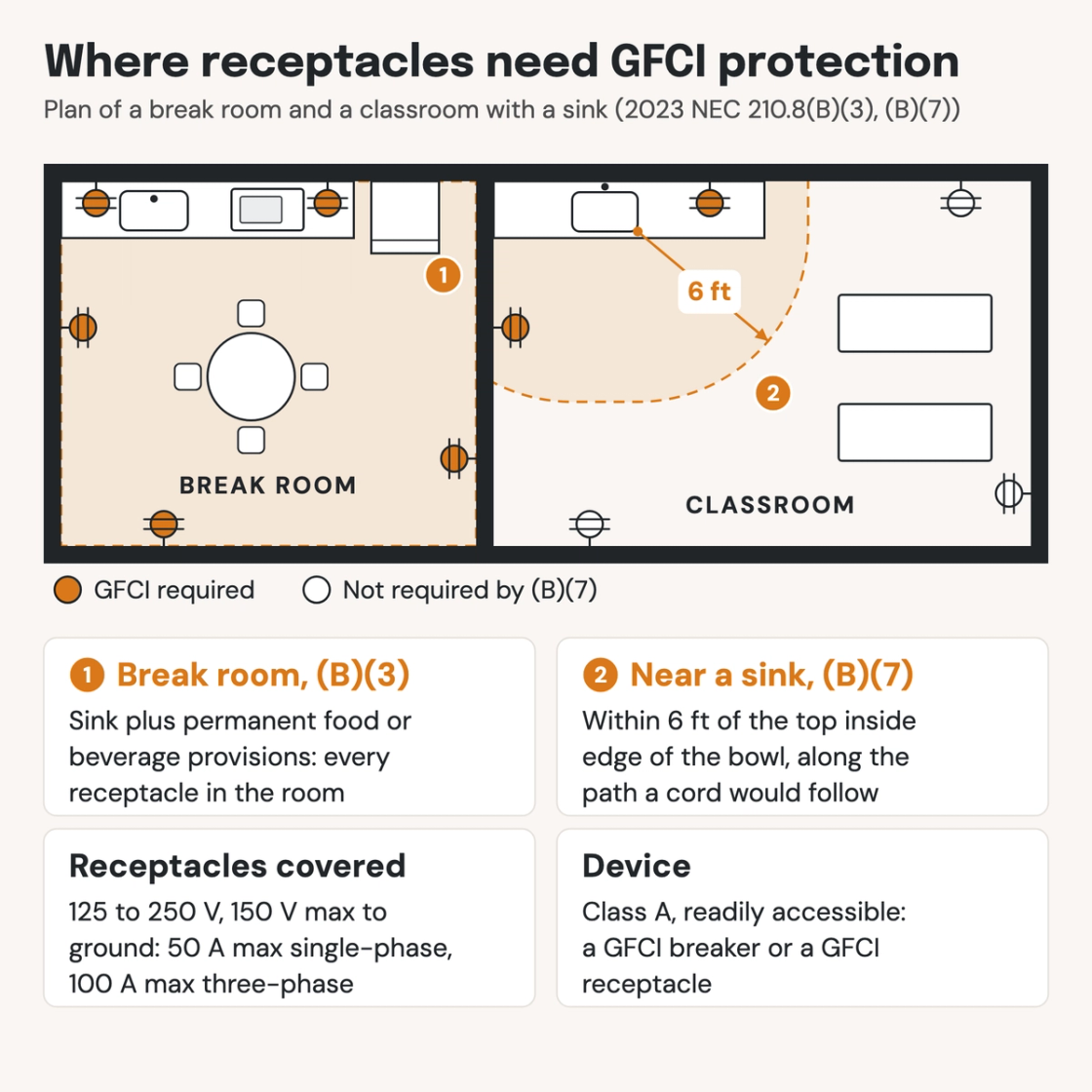
- Tag each room by its 210.8(B) item. Bathrooms, kitchens, rooftops, laundry areas and locker rooms with showers take every receptacle in them. So does a break room, coffee station or serving counter with a sink and permanent food or beverage provisions, under (B)(3) or (B)(4).
- Draw the 6-foot radius at each sink, tub, shower and aquarium. Measure from the top inside edge of a sink bowl, or the outside edge of a tub or shower. Follow the path a cord would take. Every receptacle inside the radius needs GFCI under (B)(7), (B)(13) or (B)(15).
- Check each circuit against the scope. Single-phase circuits up to 50 A and three-phase circuits up to 100 A are covered when they run at 150 V or less to ground. A 208 V receptacle on a 208Y/120 V system is in; a 480 V receptacle is out.
- Find the 210.8(D) appliances. Mark the outlets for dishwashers, ranges, wall ovens, cooktops, microwave ovens, dryers, vending machines and drinking water coolers. Hardwired outlets need GFCI as well as receptacles.
- Pick the device and show it on both drawings. A GFCI breaker protects the whole circuit; a GFCI receptacle protects itself and anything wired on its load side. Either must be readily accessible, so mark the device on the plan and the panel schedule.
- Add the service receptacles. The receptacles that 210.63 requires near rooftop HVAC equipment and indoor electrical equipment need GFCI protection too (210.8(E)).
Receptacle protection is one line of a project's code analysis, and it lands on the power plans that MEP engineers draw. The rules are in Section 210.8 of the National Electrical Code (NFPA 70); IAEI explains the kitchen and break room items in Kitchens and Areas for Food or Beverage Preparation and GFCIs. More building code requirements sit on the same sheets, which is where an AI-powered quality management system reads them.
How Pirros checks the set
The Pirros Quality Management System reviews projects against code requirements, firm standards, and project specifications, then assigns, tracks, and resolves issues before they become RFIs or rework.
- Reads every sheet in your set against the codes you pick for the project: the IBC, ADA and regional codes.
- Every finding names the sheet, the location and the section behind it.
- Findings are surfaced, never auto-applied. Your reviewer confirms, dismisses or escalates.
Requirements at a glance
| Element | Requirement | Section |
|---|---|---|
| Which receptacles | 125 to 250 V receptacles on single-phase branch circuits rated 150 V or less to ground and 50 A or less. Also receptacles on three-phase branch circuits rated 150 V or less to ground and 100 A or less. | NEC 210.8(B) |
| Voltage to ground | A 208Y/120 V system is 120 V to ground, so its 208 V single- and three-phase receptacles are covered within those ratings. A 480Y/277 V receptacle, at 277 V to ground, is not. | NEC 210.8(B) |
| Device and location | Class A GFCI protection, installed in a readily accessible location. A GFCI circuit breaker or a GFCI receptacle can provide it. | NEC 210.8 |
| Measuring distances | Distances to a sink, aquatic vessel, bathtub or shower are measured along the shortest path a cord would follow. That path may not pierce a floor, wall, ceiling or fixed barrier. | NEC 210.8 |
| Bathrooms and kitchens | Every receptacle in scope in a bathroom or a kitchen. A kitchen is an area with a sink and permanent provisions for food preparation and cooking. | NEC 210.8(B)(1), (2) |
| Food and beverage areas | Every receptacle in an area with a sink and permanent provisions for food preparation, beverage preparation or cooking. | NEC 210.8(B)(3) |
| Buffet serving areas | Every receptacle in a buffet serving area with permanent provisions for food serving, beverage serving or cooking. | NEC 210.8(B)(4) |
| Rooftops and outdoors | Every receptacle in scope on a rooftop or outdoors. | NEC 210.8(B)(5), (6) |
| Sinks | Receptacles within 6 feet of the top inside edge of a sink bowl, including those for cord-and-plug-connected appliances. | NEC 210.8(B)(7) |
| Damp and wet locations | Indoor damp and wet locations, and locker rooms with showering facilities. | NEC 210.8(B)(8), (9) |
| Garages and service bays | Garages, accessory buildings, service bays and similar areas, other than vehicle exhibition halls and showrooms. | NEC 210.8(B)(10) |
| Crawl spaces and basements | Crawl spaces at or below grade, and unfinished areas of basements. | NEC 210.8(B)(11), (12) |
| Aquatic vessels | Within 6 feet of the top inside edge or rim of aquariums, bait wells and similar open aquatic vessels or containers. | NEC 210.8(B)(13) |
| Laundry, tubs and showers | Laundry areas, and within 6 feet of the outside edge of a bathtub or shower stall. | NEC 210.8(B)(14), (15) |
| Specific appliances | The outlet for each listed appliance rated 150 V or less to ground and 60 A or less, single- or three-phase, hardwired or cord-and-plug connected. The list includes vending machines, drinking water coolers, dishwashers, electric ranges, wall-mounted ovens, counter-mounted cooking units, clothes dryers and microwave ovens. | NEC 210.8(D) |
| Equipment servicing | The 125 V, 15 or 20 A service receptacles that 210.63 requires near HVAC equipment, indoor service equipment, switchboards, switchgear, panelboards and motor control centers. | NEC 210.8(E), 210.63 |
| Health care wet procedure locations | Receptacles and fixed equipment need Class A GFCI protection where power interruption can be tolerated, or else an isolated power system. | NEC 517.20(A) |
These rules are from the 2023 NEC; many states still enforce the 2020 or 2017 edition, so check the one your jurisdiction adopted. The 2023 edition split kitchens from other food and beverage areas and added buffet serving areas and aquatic vessels. It also added ranges, wall ovens, counter-mounted cooking units, dryers and microwave ovens to 210.8(D). The 2020 edition added indoor damp locations, accessory buildings, laundry areas and the 6 feet around a tub or shower.