
Gas Pipe Sizing Chart: How to Read the IFGC Tables
Sources: 2021 International Fuel Gas Code (IFGC) Chapter 4
Check your set instantlySize gas pipe from the 2021 IFGC tables. Add up the maximum input of every appliance served, and measure the longest run from the point of delivery. Pick the table for your gas, pipe material, inlet pressure and pressure drop. Read the row at that length and choose the size that carries the load.
The Pirros Quality Management System can check the gas pipe sizes on every riser diagram against connected load and length in your set and Revit model, instantly.
How to check the code requirements
A gas sizing check reads the gas riser diagram against the equipment schedule and the supply pressure in the general notes. These steps follow the longest length method of IFGC 402.4.1.
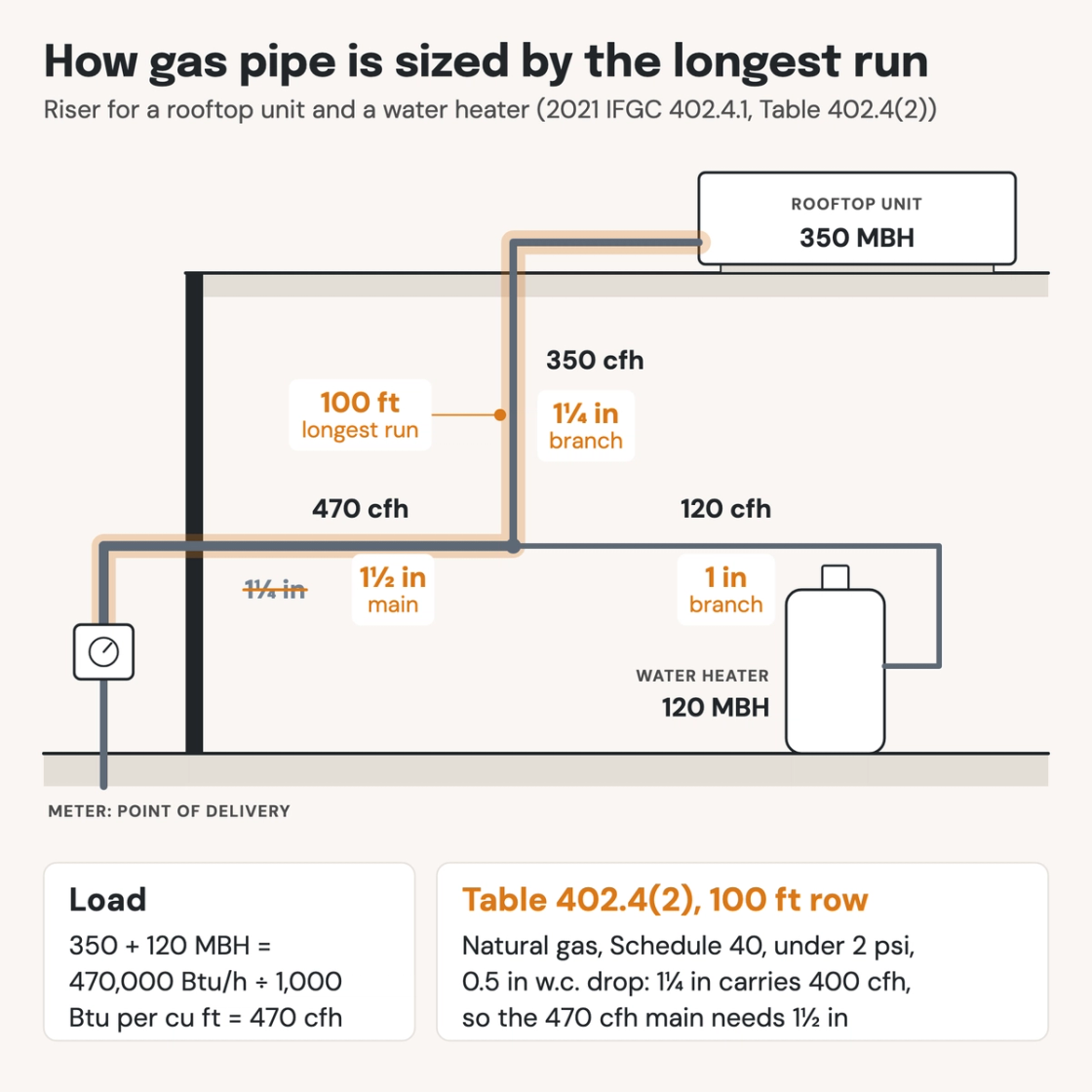
- Total the connected load. Add the maximum input of every appliance on the equipment schedule (402.2). A 350 MBH rooftop unit and a 120 MBH water heater total 470,000 Btu/h.
- Convert to cubic feet per hour. Divide by the supplier's heating value. At 1,000 Btu per cubic foot, as in the IFGC's own examples, that is 470 cfh (Appendix A).
- Measure the longest run. Take the length from the point of delivery to the most remote outlet: here, 100 feet from the meter to the rooftop unit (402.4.1).
- Pick the table. Match the gas, pipe material, inlet pressure and design drop. Natural gas in Schedule 40 pipe, under 2 psi with a 0.5 inch w.c. drop, is Table 402.4(2).
- Read each section at that length. In the 100-foot row, 1¼-inch pipe carries 400 cfh, so the 470-cfh main needs 1½ inches. The 350-cfh branch takes 1¼ inches and the 120-cfh branch 1 inch.
- Check pressure at each appliance. The design drop must leave each appliance its minimum inlet pressure (402.6). Inside the building, gas stays at 5 psig or less unless 402.7 allows more.
Gas inputs come from the equipment schedule, so Revit families that carry each appliance's input keep the load right. A code analysis covers the building-wide checks. The sizing rules are in IFGC Chapter 4 (ICC's free viewer). On a drawing set they sit on the gas riser diagrams and equipment schedules, where an AI-powered quality management system reads them. More building code requirements for MEP engineers are on the hub.
How Pirros checks the set
The Pirros Quality Management System reviews projects against code requirements, firm standards, and project specifications, then assigns, tracks, and resolves issues before they become RFIs or rework.
- Reads every sheet in your set against the codes you pick for the project: the IBC, ADA and regional codes.
- Every finding names the sheet, the location and the section behind it.
- Findings are surfaced, never auto-applied. Your reviewer confirms, dismisses or escalates.
Requirements at a glance
| Element | Requirement | Section |
|---|---|---|
| Basis | Piping carries the maximum demand and delivers at least each appliance's minimum supply pressure at its inlet. | IFGC 402.1 |
| Connected load | The sum of the maximum inputs of the appliances served, as if all run at full capacity at once. Diversity is allowed where it can be established. Adjust for altitude above 2,000 feet. | IFGC 402.2 |
| Btu/h to cubic feet per hour | Divide the total Btu/h input by the gas's heating value per cubic foot, from the gas supplier. The IFGC's informative examples use 1,000 Btu per cubic foot. | IFGC A102.1, A106.1 |
| Allowed methods | The sizing tables or equations of Section 402.4 or 402.5, a listed piping system's manufacturer's tables, or engineering methods. | IFGC 402.3 |
| The tables | Tables 402.4(1) through 402.4(37), by gas, pipe material, inlet pressure and pressure drop. Natural gas tables assume 0.60 specific gravity, and undiluted propane tables 1.50. Materials include Schedule 40 metallic pipe, semirigid copper tubing, CSST and polyethylene. | IFGC 402.4 |
| Units | Natural gas tables give capacity in cubic feet of gas per hour. Propane tables give it in thousands of Btu per hour. | IFGC Table 402.4(2), Table 402.4(25) |
| Natural gas, Schedule 40 pipe | Inlet under 2 psi: Tables 402.4(1) to 402.4(4), for drops of 0.3, 0.5, 3.0 and 6.0 inches w.c. 2 psi with a 1 psi drop: Table 402.4(5). 3 psi with a 2 psi drop: 402.4(6). 5 psi with a 3.5 psi drop: 402.4(7). | IFGC Tables 402.4(1) to 402.4(7) |
| Worked example values | Natural gas under 2 psi with a 0.5 inch w.c. drop, Schedule 40 pipe, 100 feet: 1-inch pipe carries 195 cubic feet per hour. 1¼-inch pipe carries 400, and 1½-inch pipe 600. | IFGC Table 402.4(2) |
| Equations | Equation 4-1 for gas under 1½ psi and Equation 4-2 for 1½ psi and above, for pipe or tubing with smooth inside walls. | IFGC 402.4 |
| Longest length method | Size every section from the length of the longest run, point of delivery to the most remote outlet, and that section's load. | IFGC 402.4.1 |
| Branch length method | Size the longest run as above. Size each other branch from the length between the point of delivery and the most remote outlet on that branch. | IFGC 402.4.2 |
| Hybrid pressure method | Size the higher-pressure piping to the most remote line pressure regulator. Size the piping after a regulator from that regulator to its most remote outlet. | IFGC 402.4.3 |
| Pressure drop | The design loss from the point of delivery to each appliance leaves at least the appliance's minimum inlet pressure. | IFGC 402.6 |
| Pressure inside buildings | 5 psig maximum, unless one of the listed conditions applies. These include welded or brazed joints, piping in a ventilated chase, and piping in boiler and mechanical rooms. | IFGC 402.7 |
| Outlets | Pipe is sized to supply the full number of outlets for the intended purpose. | IFGC 401.8 |
These numbers are from the 2021 IFGC; check the edition and amendments your jurisdiction enforces. NFPA 54, the National Fuel Gas Code, and the Uniform Plumbing Code carry their own sizing tables where those codes apply. IFGC Appendix A, with the worked examples, is informative and not part of the code.