NEC Article 517: Healthcare Electrical Requirements
Sources: 2023 National Electrical Code (NFPA 70), Article 517, with NFPA 99 Health Care Facilities Code
Check your set instantlyNEC Article 517 sets the wiring rules for hospitals, nursing homes, clinics and other health care facilities. Each patient bed location needs at least 8 hospital-grade receptacles in a Category 2 space and 14 in a Category 1 space. An operating room needs 36. Hospitals split their essential electrical system into life safety, critical and equipment branches.
The Pirros Quality Management System can check the receptacle count and branch circuits at every patient bed location on your enlarged power plans in your set and Revit model, instantly.
How to check the code requirements
Article 517 design runs as a chain. The room's category sets the receptacle count, the branches serving it and the wiring method, so check each room in that order.
- Get the category for every space. The facility's governing body assigns Category 1 to 4 by risk assessment under NFPA 99. Record it in the room data or the code analysis, where the power plans can read it.
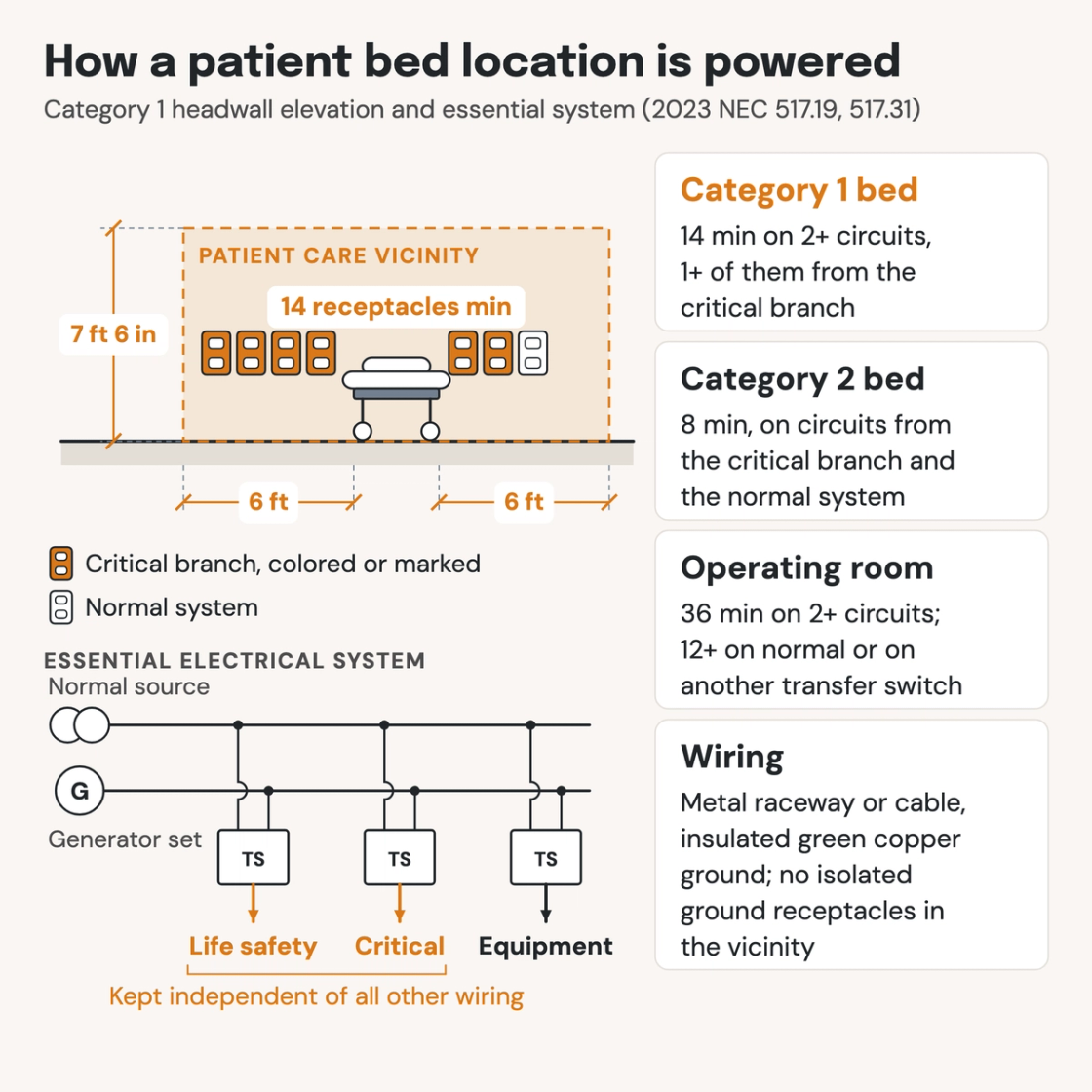
- Count receptacles at each patient bed location. A duplex counts as two. Category 2 beds need 8, Category 1 beds need 14 and each operating room needs 36. All are listed hospital grade, except locking types in operating rooms.
- Assign the branches on the panel schedule. Every bed gets at least two branch circuits with one or more from the critical branch. A Category 2 bed also needs one from the normal system.
- Mark the essential receptacles. Life safety and critical branch receptacles, or their cover plates, take a distinctive color or marking. Critical branch receptacles at Category 2 beds also show their panelboard and circuit number.
- Set the wiring method. Run every circuit serving a patient care space in a metal raceway or qualifying metal cable, with an insulated green copper grounding conductor. No isolated ground receptacles go within the patient care vicinity.
- Check wet procedure locations. Give them Class A GFCI protection where power interruption can be tolerated, or an isolated power system where it can't.
- Lay out the essential electrical system. Show the life safety, critical and equipment branches on the one-line. Keep life safety and critical branch wiring apart from everything else.
Hospitals and nursing homes are Group I-2 under the IBC, and the space categories belong in the project's code analysis. The rules are in Article 517 of the National Electrical Code (NFPA 70), with the categories and the essential electrical system in NFPA 99. On a set they sit on the enlarged power plans, panel schedules and one-lines that MEP engineers draw, beside the other building code requirements. That is where an AI-powered quality management system reads them.
How Pirros checks the set
The Pirros Quality Management System reviews projects against code requirements, firm standards, and project specifications, then assigns, tracks, and resolves issues before they become RFIs or rework.
- Reads every sheet in your set against the codes you pick for the project: the IBC, ADA and regional codes.
- Every finding names the sheet, the location and the section behind it.
- Findings are surfaced, never auto-applied. Your reviewer confirms, dismisses or escalates.
Requirements at a glance
| Element | Requirement | Section |
|---|---|---|
| Scope | Hospitals, nursing homes, limited care facilities, clinics, medical and dental offices and ambulatory care facilities. Not business offices, waiting rooms or veterinary facilities. | NEC 517.1 |
| Patient care space categories | Category 1: failure likely to cause major injury or death. Category 2: minor injury. Category 3: discomfort but not injury. Category 4: no effect on patient care. The facility's governing body assigns them by risk assessment. | NEC Article 100 · NFPA 99 |
| Patient care vicinity | 6 feet horizontally beyond the bed, chair, table or other device that supports the patient, and 7 feet 6 inches above the floor. | NEC Article 100 |
| Wiring method | Branch circuits serving patient care spaces, homeruns included, run in a metal raceway or metal cable. Its armor or sheath must qualify as an equipment grounding conductor under 250.118(A). | NEC 517.13(A) |
| Insulated grounding conductor | An insulated copper equipment grounding conductor, green along its entire length, connects receptacle grounding terminals, metal boxes and enclosures, and fixed equipment. | NEC 517.13(B) |
| Isolated ground receptacles | Not permitted within a patient care vicinity. | NEC 517.16 |
| Category 2 bed circuits | At least two branch circuits: one or more from the critical branch and one or more from the normal system. Critical branch receptacles show their panelboard and circuit number. | NEC 517.18(A) |
| Category 2 bed receptacles | At least 8 at each patient bed location. Single, duplex or quadruplex, all listed hospital grade. | NEC 517.18(B) |
| Pediatric locations | Listed tamper-resistant receptacles. The same applies in spaces the facility's governing body judges to carry similar risk. | NEC 517.18(C) |
| Category 1 bed circuits | At least two branch circuits, one or more of them from the critical branch. | NEC 517.19(A) |
| Category 1 bed receptacles | At least 14, with one or more on the normal system or on a critical branch circuit from a different transfer switch. All listed hospital grade. | NEC 517.19(B) |
| Operating rooms | At least 36 receptacles, split between at least two branch circuits. At least 12 are on the normal system or on a critical branch circuit from a different transfer switch. | NEC 517.19(C)(1) |
| Operating room receptacles | Single, duplex or quadruplex, locking or non-locking. Non-locking receptacles are listed hospital grade. | NEC 517.19(C)(2) |
| Wet procedure locations | Class A GFCI protection where power interruption can be tolerated; otherwise an isolated power system. | NEC 517.20(A) |
| Essential electrical system | In a hospital, three branches: life safety, critical and equipment. Life safety and critical branch wiring is kept independent of all other wiring. | NEC 517.31(A), 517.31(C) |
| Receptacle identification | Receptacles, or their cover plates, supplied from the life safety and critical branches have a distinctive color or marking. | NEC 517.31(E) |
| Life safety branch | Only the loads the NEC lists, such as egress lighting, exit signs and alarm systems. It also feeds selected receptacles at the generator set and transfer switch locations. | NEC 517.33, 517.33(E) |
| Critical branch | Task lighting, fixed equipment and selected receptacles serving patient care. Also clinical IT network equipment and wireless phone and paging equipment for clinical staff. | NEC 517.34(A) |
| Nursing homes | Their essential electrical system rules are in 517.40 to 517.45. Receptacles supplied from it have a distinctive color or marking. | NEC 517.40 to 517.45, 517.42(E) |
These rules are from the 2023 NEC; check the edition your state enforces. CMS recognizes the 2012 edition of NFPA 99, which references the 2011 NEC, so a hospital can answer to both. The 2014 NEC raised the counts to 8 receptacles for Category 2 beds and 14 for Category 1 beds. In 2023 the space category definitions moved to Article 100, and 517.13 now covers every circuit serving a patient care space.