NEC Article 700 Emergency System Requirements
Sources: 2023 National Electrical Code (NFPA 70) Articles 700, 701 and 702, and 2021 International Building Code (IBC) Chapter 27
Check your set instantlyNEC Article 700 covers emergency systems: legally required power for life safety loads such as egress lighting, exit signs and fire alarm. Power must arrive within 10 seconds of an outage, through transfer equipment that serves only emergency loads. Emergency wiring stays independent of other wiring, and its overcurrent devices are selectively coordinated.
The Pirros Quality Management System can check the transfer switches and emergency panels on every one-line diagram in your set and Revit model, instantly.
How to check the code requirements
Article 700 is checked on the one-line diagram. The IBC decides which loads are emergency loads, and the NEC decides how they are switched, wired and protected. Check them in that order.
- Start from the code analysis. The occupancy and height set the loads. Exit signs and egress lighting are emergency loads; elevators and smoke control are standby loads (IBC 2702.2). High-rises add more (IBC 403.4.8).
- Sort the loads by article. Put emergency loads on their own panels, legally required standby loads on others and optional loads on a third set. Emergency circuits supply only emergency loads (NEC 700.15).
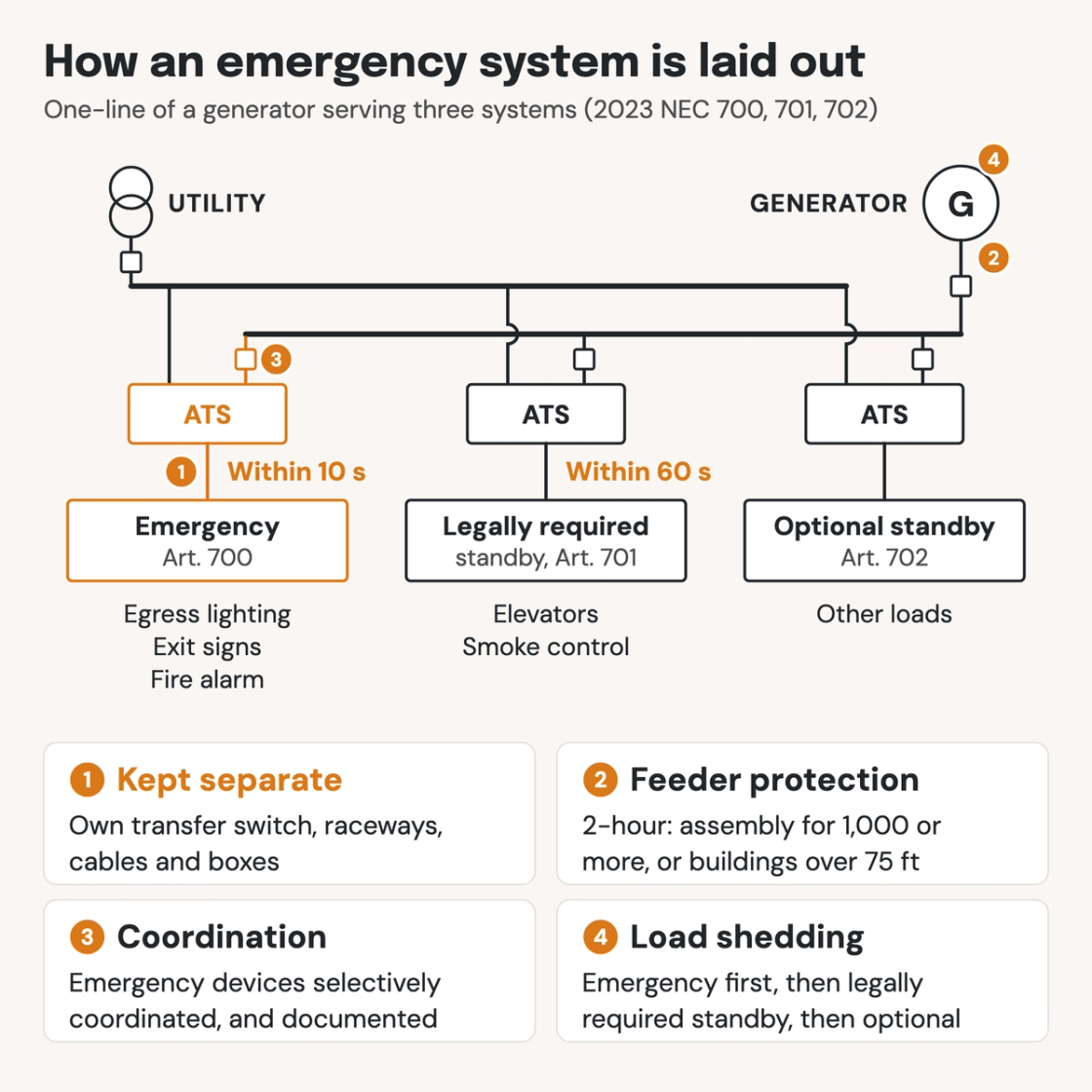
- Give emergency loads their own transfer switch. Transfer equipment for emergency loads serves nothing else, so one generator feeding all three needs separate switches (NEC 700.5). Emergency power arrives within 10 seconds (NEC 700.12).
- Route the feeders. Keep emergency wiring in its own raceways, cables and boxes (NEC 700.10(B)). In large assembly spaces and buildings over 75 feet, give feeders 2-hour protection or sprinklered routes (NEC 700.10(D)).
- Coordinate the overcurrent devices. Emergency devices coordinate selectively with the supply side. A licensed professional engineer or other qualified person selects them and documents the selection (NEC 700.32).
- Rate the generator room and sign the service. In a high-rise, a generator inside the building sits in a room of 2-hour fire barriers (IBC 403.4.8.1). A sign at the service equipment names each emergency source and where it is (NEC 700.7).
The IBC, not the NEC, sets egress lighting levels. Lighting on emergency power starts at an average of 1 footcandle at the floor, 0.1 minimum, for 90 minutes (IBC 1008.3, 2702.2.14). The occupancy group and height decide which loads are emergency loads, and the means of egress decides where exit signs and egress lighting go. Generator rooms use 2-hour fire-rated assemblies. The IBC rules are in Chapter 27 (ICC's free viewer); Article 700 is in NFPA 70 (NFPA). Pirros for MEP engineers covers families, standards and set review for electrical teams. On a drawing set these rules sit on the one-line diagram and riser, where an AI-powered quality management system reads them.
How Pirros checks the set
The Pirros Quality Management System reviews projects against code requirements, firm standards, and project specifications, then assigns, tracks, and resolves issues before they become RFIs or rework.
- Reads every sheet in your set against the codes you pick for the project: the IBC, ADA and regional codes.
- Every finding names the sheet, the location and the section behind it.
- Findings are surfaced, never auto-applied. Your reviewer confirms, dismisses or escalates.
Requirements at a glance
| Element | Requirement | Section |
|---|---|---|
| Scope | Emergency systems are legally required and classed as emergency by a governmental agency. They supply illumination, power or both automatically when the normal supply fails. | NEC 700.1, 700.2 |
| Articles 700, 701 and 702 | Emergency systems (700) protect life safety and get power within 10 seconds. Legally required standby systems (701) get it within 60 seconds. Optional standby systems (702) serve loads life safety doesn't depend on. | NEC 700.12, 701.12, 702.1 |
| Load transfer, IBC | Emergency power within 10 seconds and standby power within 60 seconds of losing primary power. An emergency system is an acceptable alternative where a standby system is required. | IBC 2702.1.4, 2702.1.7 |
| Duration | The IBC requires 2 hours minimum without refueling or recharging, unless it says otherwise. The NEC sets the same 2-hour floor for the emergency source, except battery emergency lighting and unit equipment. | IBC 2702.1.5 · NEC 700.12 |
| Emergency loads, IBC | Exit signs and means of egress illumination, each powered for 90 minutes minimum. | IBC 2702.2.6, 2702.2.14 |
| Standby loads, IBC | Elevators and platform lifts, smoke control systems and emergency voice/alarm systems. Emergency responder radio coverage runs 12 hours at full capacity. | IBC 2702.2.2, 2702.2.3, 2702.2.4, 2702.2.17 |
| High-rise loads | Emergency: exit signs and egress lighting, elevator car lighting, emergency voice/alarm, fire detection, fire alarm, electric fire pumps and the fire command center. Standby: smokeproof enclosure ventilation and detection, and elevators. | IBC 403.4.8.3, 403.4.8.4 |
| Generator room, high-rise | A generator inside the building sits in a room enclosed by 2-hour fire barriers or horizontal assemblies. Manual start and transfer are supervised from the fire command center. | IBC 403.4.8.1 |
| Installation and testing | Installed to the IFC, NFPA 70, NFPA 110 and NFPA 111. The authority having jurisdiction conducts or witnesses an acceptance test, and periodic tests are recorded in writing. | IBC 2702.1.3 · NEC 700.3 |
| Temporary source | A system with a single alternate source has a permanent means to connect a temporary source during maintenance or repair. | NEC 700.3(F) |
| Capacity and load shedding | The source carries all emergency loads that run at once. Where it also serves other loads, automatic load shedding keeps priority: emergency, then legally required standby, then optional standby. | NEC 700.4 |
| Transfer equipment | Automatic, listed for emergency use, and supplying only emergency loads. One generator serving emergency and other loads needs separate transfer switches. | NEC 700.5 |
| Signals and signs | Audible and visual signals for derangement of the source, the source carrying load, battery charger failure and ground faults. A sign at the service equipment gives the type and location of each on-site emergency source. | NEC 700.6, 700.7 |
| Wiring kept independent | Emergency wiring shares no raceway, cable, box or cabinet with other wiring. The exceptions include transfer equipment, luminaires fed from two sources and a few other listed cases. | NEC 700.10(B) |
| Feeder fire protection | Applies in assembly occupancies for 1,000 or more persons and in buildings over 75 feet high. Feeders run in fully sprinklered spaces, a 2-hour listed cable or circuit protective system, a 2-hour assembly, or 2 inches of concrete. Feeder equipment sits in sprinklered spaces or 2-hour rooms. | NEC 700.10(D) |
| Branch circuits and lighting | Emergency circuits supply only emergency loads and are never part of a multiwire branch circuit. One failed lamp can't leave a space in total darkness. An indoor service disconnect gets emergency lighting. | NEC 700.15, 700.16(B), 700.16(D), 700.19 |
| Selective coordination | Emergency overcurrent devices coordinate selectively with all supply-side devices. A licensed professional engineer or other qualified person selects them, and the selection is documented and kept available. | NEC 700.32 |
These rules are from the 2023 NEC (NFPA 70) and the 2021 IBC; check the editions and amendments your jurisdiction enforces. Subsection numbers in Article 700 have moved between NEC editions, so cite the edition on your project. Health care facilities follow Article 517 and NFPA 99 for their essential electrical systems.