Grease Interceptor Sizing: IPC Method and Example
Sources: 2021 International Plumbing Code (IPC) Section 1003
Check your set instantlyUnder the 2021 IPC, grease-laden kitchen fixtures drain through a grease interceptor; food waste disposers never do. A hydromechanical unit, often called a grease trap, is sized by flow rate under a referenced standard and holds 2 pounds of grease per gpm. A gravity unit holds the peak drain flow for 30 minutes.
The Pirros Quality Management System can check the routing of every grease fixture on your kitchen plumbing plans in your set and Revit model, instantly.
How to check the code requirements
Grease trap sizing and grease interceptor sizing are the same check. Read the kitchen plumbing plan with the food service equipment plan and the plumbing schedule.
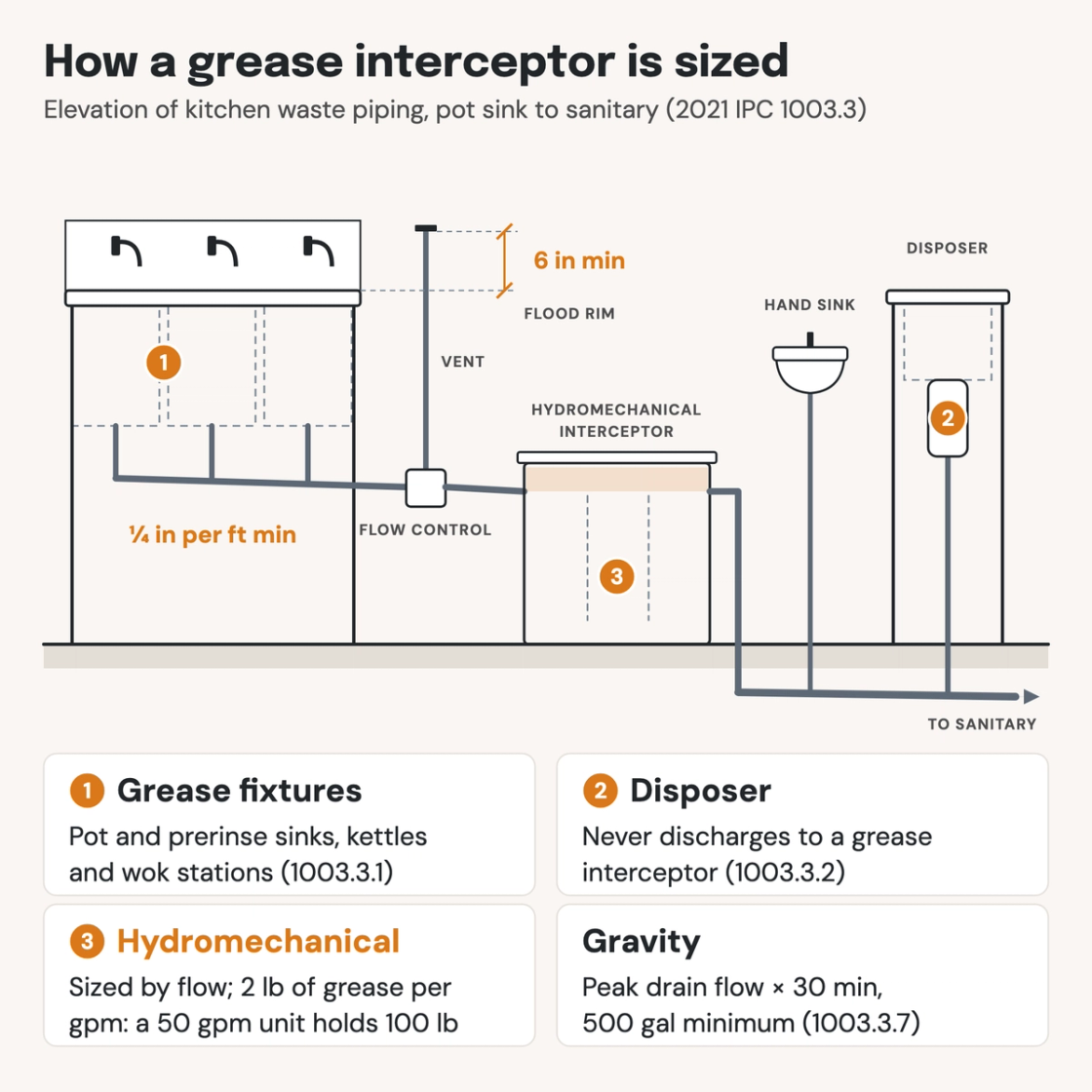
- List the grease fixtures. Mark every pot sink, prerinse sink, kettle, wok station, hood wash unit and dishwasher without a prerinse sink on the equipment plan (IPC 1003.3.1).
- Trace each waste line. Every grease fixture drains through the interceptor. A food waste disposer never does (1003.3.2), and fixtures that discharge no grease stay off it (1003.3.1).
- Size the unit for its type. Size a hydromechanical unit by flow under a standard named in 1003.3.5, at a rating no lower than that flow. Size a gravity unit at peak drain flow times 30 minutes, and 500 gallons minimum (1003.3.7).
- Check the grease capacity. The schedule should show 2 pounds of grease per gpm of rating: 100 pounds for a 50 gpm unit (Table 1003.3.5.1).
- Check the flow control and its vent. The flow-control device is vented and ends 6 inches above the flood rim, or as the maker's instructions specify (1003.3.5.2).
- Check access and the local program. The unit needs access for service (1003.10). Local pretreatment (FOG) programs often set their own sizing and sampling ports, so check those too.
Kitchen plumbing is one item on a drawing QA/QC checklist. The interceptor rules are in IPC Section 1003 (ICC's free viewer). On a drawing set they sit on the kitchen plumbing plans and plumbing schedule, where an AI-powered quality management system reads them. More code checks for MEP engineers are on the solutions page.
How Pirros checks the set
The Pirros Quality Management System reviews projects against code requirements, firm standards, and project specifications, then assigns, tracks, and resolves issues before they become RFIs or rework.
- Reads every sheet in your set against the codes you pick for the project: the IBC, ADA and regional codes.
- Every finding names the sheet, the location and the section behind it.
- Findings are surfaced, never auto-applied. Your reviewer confirms, dismisses or escalates.
Requirements at a glance
| Element | Requirement | Section |
|---|---|---|
| Where required | Interceptors are required where oil, grease, sand or other harmful substances would reach the sewer. Size, type and location follow the maker's instructions and the expected use. Waste that needs no treatment stays out. | IPC 1003.1, 1003.2 |
| Fixtures that connect | Fixtures and equipment with grease-laden waste in food preparation areas, such as restaurants, hotel and school kitchens, hospitals, bars and cafeterias. These include pot sinks, prerinse sinks, soup kettles, wok stations, and floor drains or sinks that kettles drain into. Automatic hood wash units and dishwashers without prerinse sinks connect too. | IPC 1003.3.1 |
| Only grease fixtures | An interceptor receives waste only from fixtures and equipment that allow fats, oils or grease to be discharged. | IPC 1003.3.1 |
| Where a unit can't fit | Where space or other constraints prevent installing or replacing one, interceptors may go on or above the floor, upstream of an existing interceptor. | IPC 1003.3.1 |
| Food waste disposers | Never discharge to a grease interceptor. | IPC 1003.3.2 |
| Additives | Additive dispensers are prohibited, except microbial systems complying with ASME A112.14.6 where the interceptor's maker allows them. Emulsifiers, chemicals and enzymes are prohibited. | IPC 1003.3.3 |
| Dwellings | Not required in individual dwelling units or private living quarters. | IPC 1003.3.4 |
| Hydromechanical sizing | Sized under ASME A112.14.3, A112.14.4, A112.14.6, CSA B481.3 or PDI G101. Designed and tested under ASME A112.14.3 or A112.14.4, CSA B481.1, PDI G101 or PDI G102. | IPC 1003.3.5 |
| Grease retention capacity | 2 pounds of grease per gpm of flow-through rating, for ratings of 4 to 100 gpm. Above 100 gpm, the capacity in pounds is double the rating. A 50 gpm unit holds 100 pounds. | IPC 1003.3.5.1, Table 1003.3.5.1 |
| Flow control | A device keeps the flow at or below the rated flow. It is vented and ends 6 inches minimum above the flood rim, or as the maker's instructions specify. | IPC 1003.3.5.2 |
| Automatic grease removal devices | Installed downstream of the fixtures they serve and sized for the flow of everything connected, with ready access. | IPC 1003.3.6 |
| Gravity interceptors | Capacity is the peak drain flow in gpm times 30 minutes of retention, and 500 gallons minimum. Designed and tested under IAPMO/ANSI Z1001. | IPC 1003.3.7 · IPC 202 |
| Discharge and maintenance | The outlet connects directly to the sanitary drainage system. Each interceptor has access for service, and accumulated grease and solids are removed periodically. | IPC 1003.3.8, 1003.10 |
| Slope upstream | Drainage piping upstream of a grease interceptor slopes ¼ inch per foot minimum. | IPC 704.1 |
These rules are from the 2021 IPC; check the edition and amendments your jurisdiction enforces. Local pretreatment (FOG) programs often add their own sizing and sampling ports on top of the code. Uniform Plumbing Code jurisdictions size interceptors under that code's own rules.