Transformer Clearance Requirements
Sources: 2023 National Electrical Code (NFPA 70) Article 450 and Section 110.26, and 2021 International Building Code (IBC)
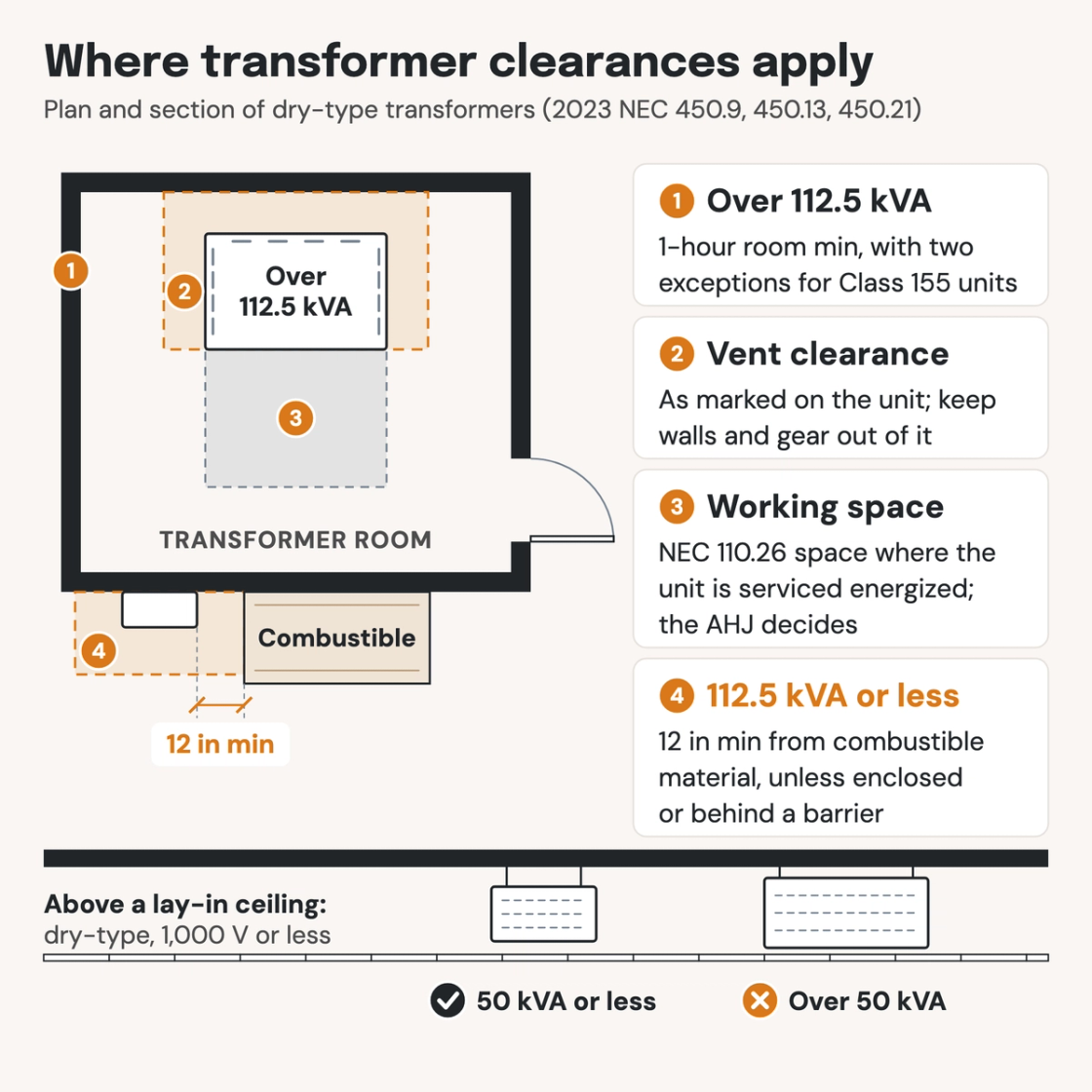
Check your set instantlyA transformer's ventilation clearance comes from its nameplate: NEC 450.9 requires the marked clearance. A dry-type unit of 112.5 kVA or less sits 12 inches from combustible material unless enclosed or behind a barrier. Larger units go in a 1-hour room, with two exceptions. Above a lay-in ceiling, the limit is 50 kVA.
The Pirros Quality Management System can check the kVA and location of every transformer on your power and reflected ceiling plans in your set and Revit model, instantly.
How to check the code requirements
Transformer clearance is four checks, made on different sheets. The schedule gives the kVA and voltage. The plans and reflected ceiling plans show where each unit sits, and the wall types show the room's rating.
- Read the transformer schedule. Note each unit's kVA, voltage and type: dry-type, oil-insulated or less-flammable liquid. The kVA decides which part of NEC 450.21 applies.
- Draw the nameplate clearance. Take the ventilation clearance from the maker's cut sheet or nameplate, not from the NEC (450.9). Draw it on the plan so walls and other equipment stay out of it.
- Check combustibles and the room. At 112.5 kVA or less, keep combustible material 12 inches away unless the unit is enclosed or behind a barrier. Over 112.5 kVA, check that the room's walls are 1-hour rated, unless an exception applies.
- Check units above ceilings. On the reflected ceiling plan, a dry-type unit above a lay-in ceiling is 50 kVA at most (450.13(B)). A larger unit goes in a room or on an open wall.
- Place the disconnect. Show it in sight of the transformer. If it is remote, make it lockable and note its location on the transformer (450.14).
- Ask about working space. Where the unit will be serviced energized, the authority having jurisdiction may require NEC 110.26 working space in front of it. Many designers draw it anyway.
A transformer room over 112.5 kVA is built from 1-hour fire-rated walls. Article 450 is in NFPA 70 (NFPA); the IBC's pointer to it is Table 509.1 in Chapter 5 (ICC's free viewer). Pirros for MEP engineers covers families, standards and set review for electrical teams. On a drawing set the transformers sit on the power plans, ceiling plans and schedules, where an AI-powered quality management system reads them.
How Pirros checks the set
The Pirros Quality Management System reviews projects against code requirements, firm standards, and project specifications, then assigns, tracks, and resolves issues before they become RFIs or rework.
- Reads every sheet in your set against the codes you pick for the project: the IBC, ADA and regional codes.
- Every finding names the sheet, the location and the section behind it.
- Findings are surfaced, never auto-applied. Your reviewer confirms, dismisses or escalates.
Requirements at a glance
| Element | Requirement | Section |
|---|---|---|
| Ventilation | Ventilation carries off the full-load losses without exceeding the transformer's temperature rating. Vent openings stay clear of walls and obstructions by the clearances marked on the transformer. | NEC 450.9 |
| Access | Readily accessible to qualified personnel for inspection and maintenance. | NEC 450.13 |
| On walls and columns | Dry-type units of 1,000 volts or less, in the open on walls, columns or structures, need not be readily accessible. | NEC 450.13(A) |
| Above a ceiling | Dry-type units of 1,000 volts or less and 50 kVA or less may sit in hollow spaces not permanently closed in. The space above a lay-in ceiling is one. Ventilation still has to be met. | NEC 450.13(B) |
| Disconnect | In sight of the transformer, or remote. A remote disconnect is lockable, and its location is marked on the transformer. | NEC 450.14 |
| Dry-type indoors, 112.5 kVA or less | 12 inches minimum from combustible material, unless separated by a fire-resistant, heat-insulated barrier. Units of 1,000 volts or less completely enclosed except for vent openings are exempt. | NEC 450.21(A) |
| Dry-type indoors, over 112.5 kVA | In a transformer room of fire-resistant construction, 1-hour minimum. Units with Class 155 or higher insulation are exempt if completely enclosed except for vent openings. They are also exempt behind a fire-resistant, heat-insulating barrier, or 6 feet horizontally and 12 feet vertically from combustibles. | NEC 450.21(B) |
| Dry-type indoors, over 35,000 volts | In a vault. | NEC 450.21(C) |
| Dry-type outdoors | In a weatherproof enclosure. Over 112.5 kVA, not within 12 inches of combustible building materials, unless Class 155 or higher and completely enclosed except for vent openings. | NEC 450.22 |
| Oil-insulated | Indoors, in a vault, with exceptions. Outdoors, buildings, combustible materials, fire escapes and door and window openings are safeguarded by space separation, fire-resistant barriers, water spray or oil confinement. | NEC 450.26, 450.27 |
| Transformer vaults | Walls and roof 3-hour, or 1-hour with automatic sprinklers, water spray, carbon dioxide or halon. Tight-fitting 3-hour doors, a 4-inch minimum sill or curb, no foreign pipes or ducts and no storage. | NEC 450.42, 450.43, 450.47, 450.48 |
| Vault doors | Exit and exit access doors serving transformer vaults are equipped with panic or fire exit hardware. Under the NEC, personnel doors open in the direction of egress. | IBC 1010.2.9.2 · NEC 450.43 |
| Room fire rating, IBC | Table 509.1 sends electrical installations and transformers to NFPA 70, Sections 450.8 to 450.48, for protection and separation. The IBC sets no incidental-use rating of its own. | IBC Table 509.1 |
| Working space | Section 110.26 applies to equipment likely to need examination, adjustment, servicing or maintenance while energized. Whether that covers a dry-type transformer is the authority having jurisdiction's call. | NEC 110.26(A) · OSHA 1910.303(g)(1)(i) |
These numbers are from the 2023 NEC (NFPA 70) and the 2021 IBC; check the editions and amendments your jurisdiction enforces. Older NEC editions set some of these limits at 600 volts rather than 1,000. Pad-mounted transformers outdoors usually follow the serving utility's standard for clearances, so check with the utility.