
Water Supply Fixture Units (WSFU) and Water Pipe Sizing
Sources: 2021 International Plumbing Code (IPC) Chapter 6 and Appendix E
Check your set instantlyA water supply fixture unit (WSFU) weights a fixture's demand on the water piping, by occupancy and supply control. A public flush-tank water closet counts 5, a flushometer-valve one 10, and a public lavatory 2. IPC Appendix E turns the total into gpm and pipe sizes, but applies only where a jurisdiction adopts it.
The Pirros Quality Management System can check the water pipe sizes on every domestic water riser against their fixture units in your set and Revit model, instantly.
How to check the code requirements
A WSFU check reads the fixture schedule and its supply controls against the domestic water riser diagram and the static pressure in the general notes. These steps follow the fixture-unit table method of IPC E104.1.
- Find the available pressure. Start from the minimum daily static pressure in the general notes. Deduct 0.5 psi per foot of rise to the highest outlet, and any equipment losses (E104.1).
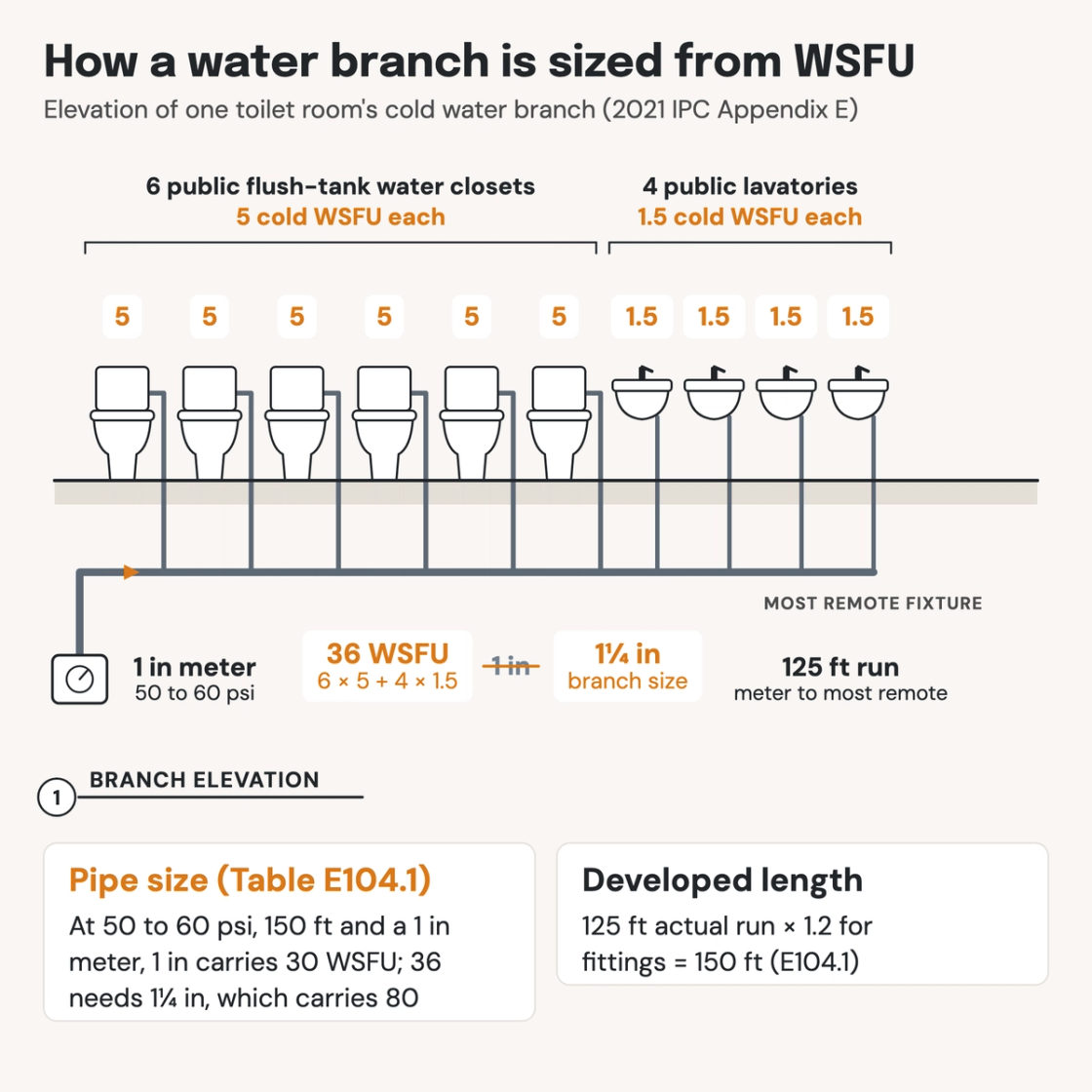
- Tag every fixture with its WSFU. Use the cold and hot values of Table E103.3(2). Six public flush-tank water closets at 5 and four public lavatories at 1.5 put 36 cold WSFU on one branch.
- Find the developed length. Multiply the actual run to the most remote fixture by 1.2 for fittings. A 125-foot run becomes 150 feet (E104.1).
- Read the pipe size. In Table E104.1 at 50 to 60 psi, 150 feet and a 1-inch meter, 1-inch pipe carries 30 WSFU. The 36-WSFU branch needs 1¼ inches, which carries 80.
- Add continuous loads in gpm. Hose bibbs, lawn sprinklers and air conditioners take no fixture units. Add their gpm to the fixture demand from Table E103.3(3) (E102.2.2).
- Check pressure at the fixtures. The most demanding outlet still needs its Table 604.3 flow pressure, such as 35 psi for a siphonic flushometer valve. Above 80 psi static, add a pressure-reducing valve (604.8).
Water supply fixture units size the water piping; drainage fixture units size the drains, from a separate table in IPC Chapter 7. How many fixtures a building needs comes first, in the code analysis. The sizing method is in IPC Appendix E (ICC's free viewer). On a drawing set it sits on the fixture schedule and domestic water risers, where an AI-powered quality management system reads it. More building code requirements for MEP engineers are on the hub.
How Pirros checks the set
The Pirros Quality Management System reviews projects against code requirements, firm standards, and project specifications, then assigns, tracks, and resolves issues before they become RFIs or rework.
- Reads every sheet in your set against the codes you pick for the project: the IBC, ADA and regional codes.
- Every finding names the sheet, the location and the section behind it.
- Findings are surfaced, never auto-applied. Your reviewer confirms, dismisses or escalates.
Requirements at a glance
| Element | Requirement | Section |
|---|---|---|
| Legal status | Appendix E is not mandatory unless the adopting ordinance references it. Chapter 6 requires design to accepted engineering practice, by pipe sizing methods the code official approves. | IPC Appendix E · IPC 604.1 |
| What a WSFU measures | A load value for each fixture, by occupancy (private or public) and type of supply control, given as cold, hot and total. For fixtures with both supplies, hot and cold are each three-fourths of the total. | IPC Table E103.3(2) |
| Water closets | Public flushometer valve: 10 WSFU. Public flush tank: 5. Private flushometer valve: 6. Private flush tank: 2.2. Flushometer tank, public or private: 2. All cold water. | IPC Table E103.3(2) |
| Lavatories and service sinks | Public lavatory: 1.5 cold, 1.5 hot, 2 total. Private lavatory: 0.5 cold, 0.5 hot, 0.7 total. Service sink: 2.25 cold, 2.25 hot, 3 total. | IPC Table E103.3(2) |
| WSFU to gpm | Table E103.3(3) converts a WSFU total to demand in gpm. It has one curve for systems mostly on flush tanks and one for systems mostly on flushometer valves. | IPC E103.3, Table E103.3(3) |
| Continuous loads | Hose bibbs, lawn sprinklers and air conditioners take no fixture units. Estimate their demand in gpm and add it to the fixture demand. | IPC E102.2.2, E103.3 |
| Segmented loss method | Start from the minimum available pressure. Subtract the pressure the highest fixture needs, and losses through the meter, tap, backflow preventers, filters and fittings. Subtract elevation at 0.433 psi per foot, and spend what remains on pipe friction. | IPC E103.3 |
| Available pressure (table method) | Start from the minimum daily static pressure at the source. Deduct 0.5 psi for each foot the highest outlet sits above it, plus equipment losses. With a pressure-reducing valve, use 80 percent of source pressure or the valve setting, whichever is smaller. | IPC E104.1 |
| Developed length (table method) | The actual length from the source to the most remote fixture, times 1.2 for fittings. Read Table E104.1 at that length and pressure range. The water service is ¾ inch minimum. | IPC E104.1, Table E104.1 |
| Worked example values | At 50 to 60 psi and 150 feet with a 1-inch meter, 1-inch distribution pipe carries 30 WSFU and 1¼-inch pipe carries 80. | IPC Table E104.1 |
| Flow pressure at fixtures | Each outlet gets at least its Table 604.3 flow rate and flow pressure at peak demand. A siphonic flushometer-valve water closet needs 25 gpm at 35 psi. A flushometer tank needs 1.6 gpm at 20 psi, and a public lavatory 0.4 gpm at 8 psi. | IPC 604.3, Table 604.3 |
| Design pressure | Design for the minimum street pressure where it fluctuates. Add a booster where pressure can't meet Table 604.3. Above 80 psi static, a pressure-reducing valve brings it to 80 psi maximum. | IPC 604.6, 604.7, 604.8 |
| Maximum flow rates | Water closet: 1.6 gallons per flush. Urinal: 1.0 gallon per flush. Public lavatory: 0.5 gpm. Showerhead: 2.5 gpm at 80 psi. | IPC 604.4, Table 604.4 |
| Fixture supply | Minimum sizes are in Table 604.5. The fixture supply pipe ends not more than 30 inches from the fixture connection. | IPC 604.5, Table 604.5 |
These numbers are from the 2021 IPC; check the edition and amendments your jurisdiction enforces. Appendix E applies only where the adopting ordinance references it; elsewhere the code official approves the sizing method (604.1). Uniform Plumbing Code jurisdictions use that code's own fixture unit values and sizing tables.