ASHRAE 15 Refrigerant Machinery Room Requirements
Sources: 2021 International Mechanical Code (IMC) Chapter 11 and ASHRAE Standard 15, with International Fire Code (IFC) Section 608
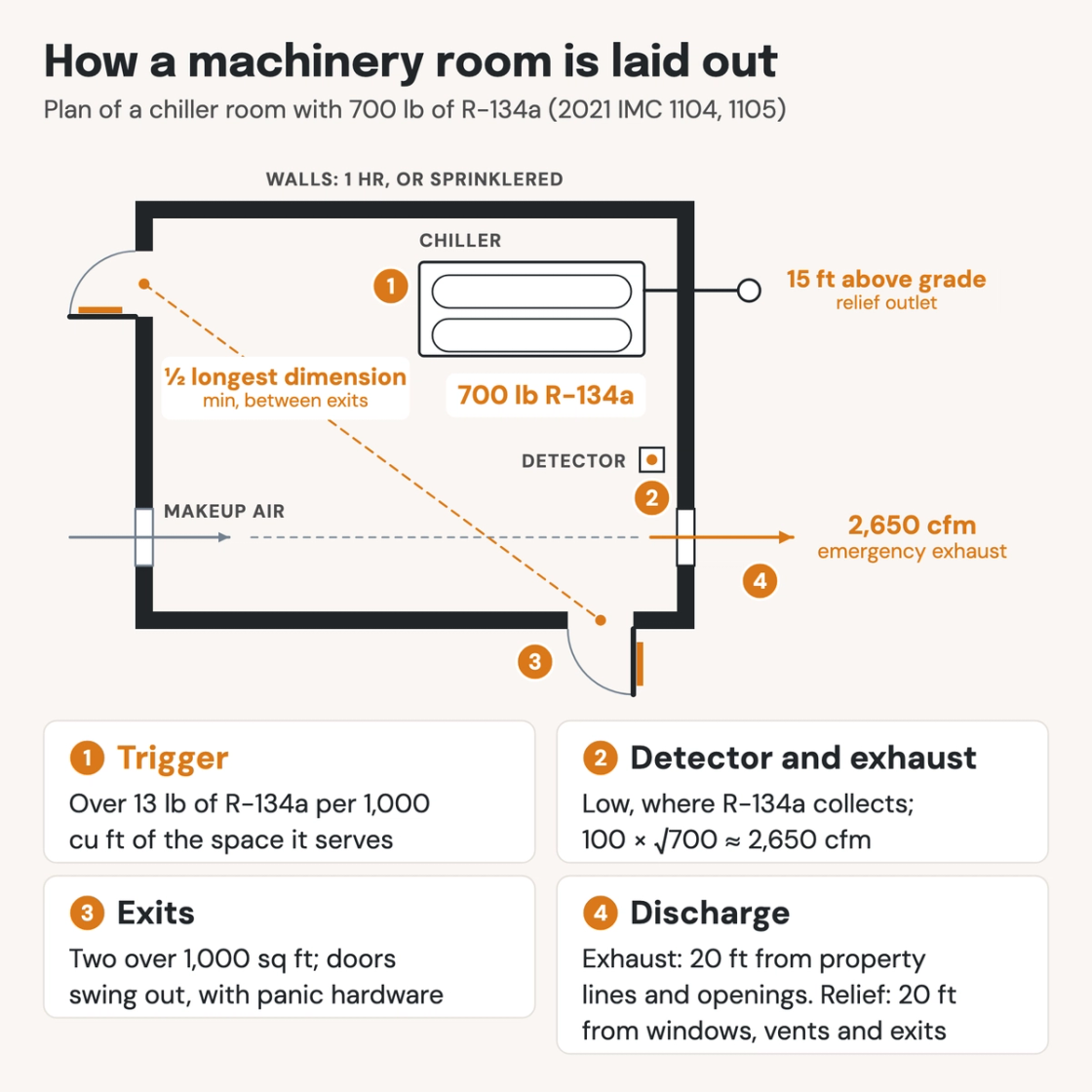
Check your set instantlyA refrigeration system needs a machinery room when one circuit holds more refrigerant than IMC Table 1103.1 allows for the smallest space it serves. For R-134a, that is 13 pounds per 1,000 cubic feet. The room needs a refrigerant detector, exhaust to outdoors at 100 × √G cfm in an emergency, and two exits over 1,000 square feet.
The Pirros Quality Management System can check the machinery room exhaust on your equipment schedules against each system's refrigerant charge in your set and Revit model, instantly.
How to check the code requirements
Start with the equipment schedule: refrigerant, safety group and charge for each circuit. Then check the room on the plan, door by door and fan by fan.
- Read the refrigerant and charge. Take each circuit's refrigerant and pounds off the schedule, then look up its safety group and Table 1103.1 amount (IMC 1103.1).
- Run the trigger calculation. Divide the charge by the volume of the smallest occupied space the system serves, in thousands of cubic feet. Above the table amount, the system needs a machinery room or an outdoor location (IMC 1104.2).
- Size the exhaust. Normal: the larger of 0.5 cfm per square foot or 20 cfm per person, and the 18°F temperature-rise airflow. Emergency: 100 × √G cfm, so 700 pounds of R-134a needs about 2,650 cfm (IMC 1105.6.3).
- Place the detector and the exhaust intake. Put both where a leak will collect, based on the refrigerant's density relative to air (IMC 1105.6.1.1, IFC 608.9.1).
- Check the exits. Over 1,000 square feet, show two exits separated by half the room's longest dimension. Doors swing out, self-close and carry panic hardware (IMC 1105.9).
- Check the discharges. Exhaust discharges 20 feet from property lines and openings (IMC 1105.6.1). Relief vents discharge 15 feet above grade and 20 feet from windows, vents and exits (IMC 1105.7).
- Check the enclosure. Show a 1-hour separation or sprinklers (IBC Table 509.1). Then confirm no open-flame appliance draws its combustion air from the room (IMC 1105.5).
The IMC sorts occupancies for refrigeration in its own Section 1103.2, apart from the IBC's occupancy classification. The room is a 1-hour fire barrier unless sprinklered, and its doors are exit access doorways. The rules are in IMC Chapter 11 (ICC's free viewer); ASHRAE sells Standards 15 and 34. On a drawing set the room sits on the mechanical plans and equipment schedules, which is where an AI-powered quality management system reads them. See Pirros for MEP engineers.
How Pirros checks the set
The Pirros Quality Management System reviews projects against code requirements, firm standards, and project specifications, then assigns, tracks, and resolves issues before they become RFIs or rework.
- Reads every sheet in your set against the codes you pick for the project: the IBC, ADA and regional codes.
- Every finding names the sheet, the location and the section behind it.
- Findings are surfaced, never auto-applied. Your reviewer confirms, dismisses or escalates.
Requirements at a glance
| Element | Requirement | Section |
|---|---|---|
| Which standard applies | Systems using any refrigerant other than ammonia follow IMC Chapter 11 and ASHRAE 15. Ammonia systems follow IIAR 2 to 5 instead. | IMC 1101.1.1, 1101.1.2 |
| Safety groups | Classified per ASHRAE 34. The letter is toxicity: A low, B high. The number is flammability: 1 no flame propagation, 2 low, 2L low with a low burning velocity, 3 high. | IMC 1103.1, 202 |
| Common refrigerants | A1: R-134a, R-410A, R-513A. A2L: R-32, R-454B, R-452B, R-1234yf. A3: R-290 (propane). The IMC treats Class 2L as a subclass of Class 2. | IMC Table 1103.1 |
| When a machinery room is required | Where the refrigerant in one independent circuit exceeds the Table 1103.1 amount. Every refrigerant-containing part then goes outdoors or in a machinery room. | IMC 1104.2 |
| Table 1103.1 amounts | Pounds per 1,000 cubic feet of occupied space: R-134a 13, R-410A 26, R-513A 20, R-454B 22, R-32 4.8, R-290 0.56. | IMC Table 1103.1 |
| Space volume | Use the smallest enclosed occupied space the system serves. For a coil in a duct system, use the smallest space it serves. Where airflow cannot drop below a quarter of maximum, use the whole area served. | IMC 1104.4 |
| Exemptions and reductions | Listed equipment holding 6.6 pounds or less needs no machinery room. Institutional occupancies use half the table amounts, except in kitchens, laboratories and mortuaries. | IMC 1104.2, 1104.2.1 |
| Flammable refrigerant totals | Groups A2, B2, A3 and B3: 550 pounds total in the occupied areas or machinery rooms of an institutional occupancy. 1,100 pounds total in any building unless approved. | IMC 1104.2.1, 1104.3.3 |
| Comfort cooling refrigerants | Under the 2024 IMC, high-probability systems for human comfort use A1 or A2L refrigerants. Exceptions: listed equipment holding 6.6 pounds or less in residential occupancies, or 22 pounds or less in commercial. | 2024 IMC 1104.3.1 |
| Construction | Built per the IBC. A refrigerant machinery room is an incidental use: a 1-hour separation or an automatic sprinkler system. | IMC 1105.1 · IBC Table 509.1 |
| Open flames | No open-flame appliance that draws combustion air from the room, unless its combustion air is ducted and sealed or a refrigerant detector shuts it off. Water (R-718) and carbon dioxide (R-744) systems are exempt. | IMC 1105.5 |
| Refrigerant detector | At an approved location where leaked refrigerant will collect. It sounds audible and visible alarms inside and outside each entrance and signals an approved location. The trigger is the lower of the TLV-TWA or 25 percent of the LFL. | IMC 1105.3 · IFC 608.9, 608.9.1 |
| Equipment shutdown | Refrigeration equipment in the room stops at the detector's upper detection limit or 25 percent of the LFL, whichever is lower. | IFC 608.9.1 |
| Exhaust | Mechanical exhaust to outdoors, discharged 20 feet or more from a property line or openings into buildings. Exhaust intakes sit where leaked refrigerant will concentrate. Makeup air replaces the exhaust, and the ducts serve no other area. | IMC 1105.6, 1105.6.1, 1105.6.1.1, 1105.6.2 |
| Normal ventilation | While occupied, the larger of 0.5 cfm per square foot or 20 cfm per person, and the airflow that holds the temperature rise to 18°F. | IMC 1105.6.3.1 |
| Emergency ventilation | When the detector alarms, Q = 100 × √G cfm (Equation 11-2). G is the pounds of refrigerant in the largest system with any part in the room. 700 pounds gives about 2,650 cfm. | IMC 1105.6.3.2 |
| Relief discharge | Relief devices, fusible plugs and purge systems discharge outdoors. The outlet sits 15 feet or more above grade and 20 feet or more from windows, ventilation openings or exits. | IMC 1105.7 |
| Exits | Over 1,000 square feet: two exits or exit access doorways, separated by half the room's maximum horizontal dimension. Every point within 150 feet of one. Doors swing outward, fit tightly, self-close and have panic hardware. | IMC 1105.9 |
| Flammable refrigerant rooms | Rooms with A2, B2, A3 or B3 refrigerants also meet Section 1106. That means no open flames or hot surfaces over 800°F, and electrical work to NFPA 70 Class I, Division 2. | IMC 1104.2, 1106.2, 1106.3 |
| A2L rooms, 2021 IMC | May skip Class I, Division 2 wiring if detectors at or below 25 percent of the LFL start an emergency exhaust. The exhaust follows ASHRAE 15 or Table 1106.4.2, such as 32,600 cfm for R-32, with manual shutdown and supervised circuits. | IMC 1106.4, Table 1106.4.2 |
| A2L rooms, 2024 IMC | Detectors alarm and start ventilation within 300 seconds at the occupational exposure limit, and within 15 seconds at the Table 1103.1 concentration. No open flames or hot surfaces over 1,290°F. Ventilation per ASHRAE 15. | 2024 IMC 1106.4.1, 1106.4.2, 1106.4.3 |
| Remote controls | For flammable refrigerants: a break-glass, off-only switch for compressors, refrigerant pumps and automatic valves, and an on-only switch for the ventilation. Both sit just outside the room, beside its main entrance. | IMC 1106.5 · IFC 608.10 |
These numbers are from the 2021 IMC and IFC, which reference ASHRAE 15-2019 and 34-2019; check the edition your jurisdiction enforces. ASHRAE's current editions are 15-2024 and 34-2024, with 15.2-2024 for residential systems. The 2024 IMC limits high-probability comfort systems to A1 and A2L refrigerants and rewrites the A2L machinery room rules. ASHRAE 15-2024 updated the effective dispersal volume charge equations and clarified how flammability and exposure limits tie to Standard 34.